






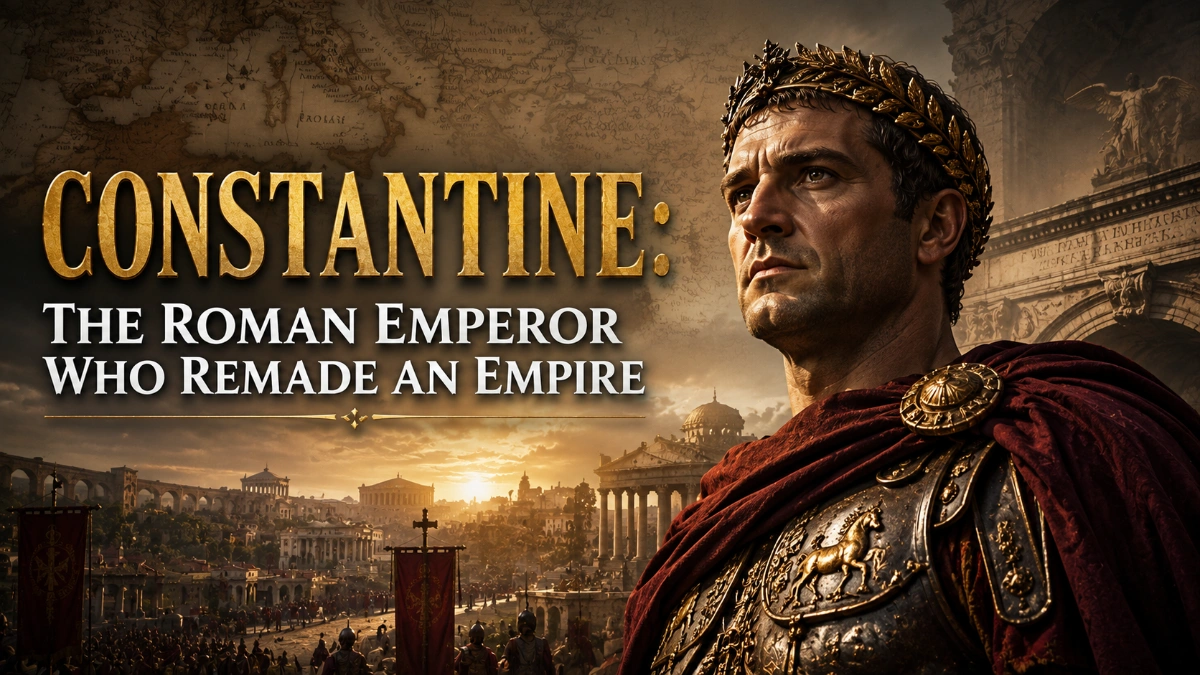
constantine: Life, Conversion and Legacy Constantine the Great was a Roman emperor from 306 to 337 CE. He reunited the empire after civil war, ended the persecution of Christians through the Edict of Milan, supported the church, and founded Constantinople—changes that reshaped Roman government, Christianity, and the eastern Mediterranean for centuries. Who Was Constantine the […]
constantine: Life, Conversion and Legacy
Constantine the Great was a Roman emperor from 306 to 337 CE. He reunited the empire after civil war, ended the persecution of Christians through the Edict of Milan, supported the church, and founded Constantinople—changes that reshaped Roman government, Christianity, and the eastern Mediterranean for centuries.
Who Was Constantine the Great?
Constantine I, widely known as Constantine the Great, was a fourth-century Roman emperor and one of the most consequential rulers in Roman history. Born at Naissus, he was the son of Constantius I and Helena; he rose from a military and dynastic background to become sole emperor in 324 CE.
His importance rests on more than his battlefield victories. Constantine changed Christianity’s legal standing, redirected imperial attention toward the eastern provinces, and established Constantinople as a new imperial capital. Those decisions helped define the late Roman world and influenced both Byzantine and medieval Christian history.
Constantine at a glance
| Key fact | Detail |
| Name | Flavius Valerius Constantinus, or Constantine I |
| Reign | 306–337 CE |
| Sole rule | 324–337 CE |
| Associated events | Battle of Milvian Bridge, Edict of Milan, Council of Nicaea, foundation of Constantinople |
| Death | 22 May 337 CE, near Nicomedia |
| Historical importance | He made Christianity a legally tolerated and imperially favored religion, while creating a new eastern capital. |
Constantine did not make Christianity the official religion of the Roman Empire. That happened later under Theodosius I. His role was different, but decisive: he moved Christianity from persecution toward official protection and patronage.
Early Life and Rise to Power
Constantine came of age during a difficult period for the Roman Empire. Decades of military pressure, political instability, and rapid imperial succession had weakened central authority and made succession especially dangerous.
Diocletian attempted to stabilize the empire through the Tetrarchy, a system of shared rule involving two senior emperors and two junior emperors. The design recognized that the empire was too large for one ruler to govern effectively, but it did not eliminate rivalry when senior rulers retired or died.
Family Background and the Tetrarchy
Constantine’s father, Constantius I, rose through the imperial hierarchy and eventually became a senior emperor in the west. Constantine spent part of his early career at Diocletian’s court, where he gained exposure to military command and the realities of imperial politics.
When Constantius died in Britain in 306, his troops proclaimed Constantine emperor. That acclaim did not settle the succession; instead, it placed Constantine among several rulers competing for territory, legitimacy, and the loyalty of the army.
Becoming Emperor in 306 CE
Constantine established his power first in Britain and Gaul. He built support among western armies and provincial communities while avoiding immediate confrontation with every rival claimant.
Rome, however, was controlled by Maxentius, another contender for imperial authority. The conflict between the two men became unavoidable, leading Constantine into Italy and toward the event most closely associated with his religious turn: the Battle of Milvian Bridge.
The Battle of Milvian Bridge and the Vision
In 312 CE, Constantine confronted Maxentius near Rome at the Battle of Milvian Bridge. Constantine’s victory removed his principal western rival, while Maxentius died during the retreat.
The battle became inseparable from a later Christian tradition that Constantine received a divine sign before the fighting. Accounts differ in their details, but they associate his victory with a Christian symbol and the message commonly rendered as “In this sign, conquer.”
Why the battle mattered
Milvian Bridge gave Constantine control of Rome and made him the leading ruler in the west. More importantly, it offered a powerful political setting for the claim that the Christian God had aided an emperor in a Roman civil war.
After 312, Constantine increasingly supported Christianity in visible and practical ways. The change did not immediately remove all traditional Roman religious practices, but it marked a decisive break from the policies of persecution associated with earlier emperors.
Conversion: belief, policy, or both?
Constantine’s religious commitment remains a matter of historical debate. He publicly patronized Christianity, supported churches, intervened in disputes among Christians, and received baptism shortly before his death.
These actions leave little doubt that Christianity became central to his public rule. They do not, however, provide a simple answer to questions about his private motives. Historians differ over whether he should be understood chiefly as a sincere convert, a pragmatic ruler, or a figure whose personal belief and political interests became intertwined.
The Edict of Milan and Religious Toleration
In 313 CE, Constantine and Licinius issued the policy traditionally called the Edict of Milan. It established religious toleration and ended the legal persecution of Christians that had characterized the preceding era.
The change had direct consequences. Christians could worship openly and seek the restoration of property that had been confiscated during persecution. The church could now function publicly across the empire rather than surviving under the pressure of hostile state policy.
What the Edict of Milan did—and did not do
The Edict of Milan did not declare Christianity the official religion of Rome. Nor did it eliminate other religious traditions from imperial life.
It did establish a new legal relationship between the state and Christianity. The faith was no longer treated as an unlawful threat, and Constantine’s subsequent patronage gave Christian institutions influence that they had not previously possessed.
The wider religious shift
Constantine’s reign did not produce an instant Christian empire. Traditional cults, temples, and beliefs persisted, and religious diversity remained a fact of Roman life.
Yet imperial support changed the balance of power. Bishops acquired more public importance, churches received resources, and Christian disputes became matters that could draw the attention of the emperor. The result was a new relationship between state authority and religious institutions.
Path to Sole Emperor: Defeating Licinius
After Maxentius’s defeat, Constantine controlled the west while Licinius held power across much of the east. Their partnership was temporary, shaped by political necessity rather than lasting trust.
In 324 CE, Constantine defeated Licinius and became sole emperor of the Roman Empire. The victory ended the divided rule that had persisted since the collapse of the Tetrarchic system.
Why sole rule mattered
Sole rule allowed Constantine to apply policy across the whole empire. He could pursue administrative reforms, adjust military organization, direct investment toward the east, and expand his patronage of Christian institutions without sharing authority with an equal imperial partner.
The reunification also magnified the importance of his choices. Constantine’s actions were no longer regional experiments in the western provinces; they became imperial policy with consequences from Britain to Egypt and from the Balkans to North Africa.
Founding Constantinople
Constantine refounded the ancient city of Byzantium as Constantinople, the “City of Constantine,” and dedicated it as a new imperial capital in 330 CE. This was one of the most consequential urban and strategic decisions of late Roman history.
The location had clear advantages. Positioned between Europe and Asia and near major sea routes, Constantinople was close to the Balkans, Anatolia, the Black Sea, and the eastern Mediterranean. It also lay nearer to the wealthy eastern provinces and several important military frontiers.
A new capital, not an instant replacement
Rome did not cease to matter when Constantinople was dedicated. It retained immense prestige as the old imperial center and a city of powerful cultural and political symbolism.
Nevertheless, Constantine’s decision recognized an important reality: the empire’s strategic and economic weight was increasingly centered in the east. The new capital provided a more advantageous base for administration, defense, trade, and imperial ceremony.
How Constantinople shaped later history
Constantinople became a major center of government, commerce, and Christian culture. It remained the capital of the eastern Roman Empire—later called the Byzantine Empire—for more than a millennium.
Its survival gave Roman political traditions a powerful eastern home after the western empire fragmented. The city’s influence later extended through diplomacy, trade, scholarship, art, law, and religious life across Europe and the Mediterranean world.
Constantine and the Christian Church
Constantine did not create Christianity or settle every question of Christian doctrine. His historical importance lies in the protection, resources, and political attention he brought to a church that had recently faced persecution.
He supported church building, encouraged the production of Christian texts, and intervened when disagreements threatened church unity. His reign made bishops and theological controversies more visible in public and imperial affairs.
The Council of Nicaea
In 325 CE, Constantine convened the First Council of Nicaea to address the dispute surrounding Arius and disagreements about the relationship between Jesus Christ and God the Father.
The council produced decisions of enduring importance, but it did not end controversy. Disputes linked to Arianism continued for decades, showing that imperial sponsorship could convene church leaders and encourage unity without simply resolving theological conflict.
What Nicaea reveals about Constantine’s rule
Nicaea demonstrated that Constantine regarded religious division as a public problem with political consequences. A divided church could intensify instability; agreement among bishops could support cohesion across a large and diverse empire.
The council was not merely an imperial order. Bishops debated doctrine and represented varying regional traditions. Constantine served as convener and patron, while theological argument remained the work of Christian leaders themselves.
Baptism near the end of his life
Constantine was baptized shortly before his death in 337 CE. Delayed baptism was not unusual in the period, when some Christians postponed it until later in life.
His late baptism should therefore be considered within the religious practices of his time. It neither proves nor disproves the sincerity of his earlier commitment; it illustrates the evolving relationship between Christian belief, ritual, and imperial authority in the fourth century.
Reforms and Governance
Constantine’s legacy was not confined to religion and the founding of a city. He also changed important aspects of administration, military organization, and currency, strengthening systems that would shape the later Roman state.
Those reforms were responses to an empire that required reliable taxation, rapid military deployment, secure frontiers, and effective governance across long distances.
Imperial administration under Constantine became more formalized and centralized. Court structures, officials, and administrative divisions played an increasingly important role in governing the empire’s provinces.
This enhanced the state’s capacity to collect revenue, coordinate armies, and implement policy. It also made government more bureaucratic, placing more of the empire’s daily administration in the hands of appointed officials rather than local political institutions.
Military and monetary change
Constantine reorganized elements of the military to meet the needs of a vast empire facing pressures on multiple frontiers. The reforms helped create a more flexible military structure capable of responding to threats.
He also introduced the gold solidus, a stable coinage that became influential in late Roman and Byzantine finance and trade. Its durability underlined a broader objective of his reign: preserving imperial power through stronger institutions as well as military victory.
Death, Succession, and Family Controversies
Constantine died on 22 May 337 CE near Nicomedia, while preparing for a campaign against Persia. His sons Constantine II, Constantius II, and Constans inherited the empire.
The succession did not create durable unity. Rivalry among the brothers led to conflict, and Constantius II later became sole ruler. This outcome exposed a persistent problem in Roman monarchy: even a ruler who reunited the empire could not always guarantee an orderly transfer of power.
The executions of Crispus and Fausta
In 326 CE, Constantine’s son Crispus and his wife Fausta were executed. The surviving ancient accounts are incomplete and sometimes contradictory, leaving historians unable to establish a single certain explanation.
The episode complicates idealized portraits of Constantine. It also reveals how dangerous succession politics could be within an imperial household, where personal relationships, dynastic interests, and public authority were tightly connected.
A ruler of contradictions
Constantine was a battlefield commander, imperial reformer, Christian patron, and autocrat. He promoted a faith associated with humility and moral discipline while ruling through the concentrated authority, ceremony, and family politics of Roman monarchy.
These tensions are not peripheral to his story. They are essential to understanding how a Roman emperor could foster a Christian political order while still operating within the realities of fourth-century imperial power.
Legacy: Why Is Constantine Called “the Great”?
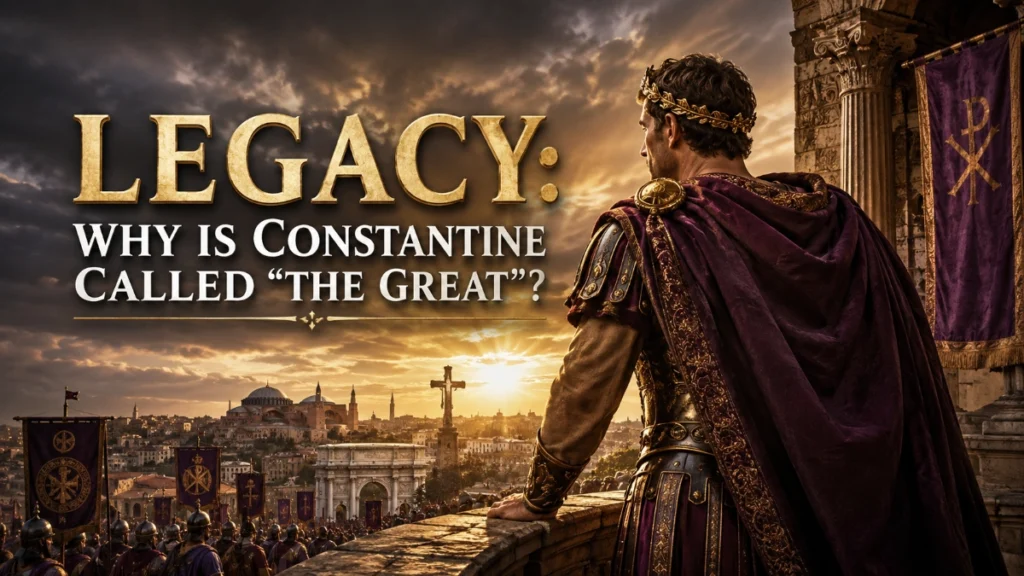
Constantine is called “the Great” because he changed several foundations of imperial life at once. He reunited the Roman Empire, ended persecution of Christians, strengthened church institutions, and founded Constantinople as a new imperial capital.
His reign marked a transition toward the late Roman and Byzantine worlds. Rome did not become instantly Christian, permanently unified, or free from political conflict, but Constantine’s decisions set powerful long-term changes in motion.
Constantine’s major achievements
- He became sole ruler of the Roman Empire in 324 CE after defeating Licinius.
- He helped end the persecution of Christians through the Edict of Milan in 313 CE.
- He supported the church and convened the First Council of Nicaea in 325 CE.
- He established Constantinople as an imperial capital in 330 CE.
- He reshaped administrative, military, and monetary structures for the late Roman state.
Constantine’s legacy in perspective
Constantine did not single-handedly create the Byzantine Empire, convert every Roman to Christianity, or end theological disputes. Those developments unfolded across generations through the actions of emperors, bishops, soldiers, officials, and local communities.
He did, however, alter the direction of the empire. The public rise of Christianity, the prestige of Constantinople, and the political culture of the eastern Roman world all bear the mark of Constantine’s reign. That is why he remains one of the defining figures of Roman history.
Frequently Asked Questions
Constantine was the first Roman emperor to profess Christianity and openly support it, although the empire did not become officially Christian during his reign.
No. Constantine legalized and favored Christianity, but Theodosius I later made Nicene Christianity the official religion of the Roman Empire.
The Edict of Milan was the 313 CE policy associated with Constantine and Licinius that established religious toleration and ended the legal persecution of Christians.
The Battle of Milvian Bridge in 312 CE gave Constantine control of Rome, eliminated Maxentius as a rival, and became linked to Constantine’s adoption of Christian symbolism.
Later Christian accounts say Constantine saw a divine sign connected with a Christian symbol before the battle. The accounts differ in detail, so historians treat the tradition with care.
Constantine became sole emperor in 324 CE after defeating Licinius.
Constantine selected the site because of its strategic position between Europe and Asia, access to important sea routes, proximity to eastern provinces, and military advantages.
Constantinople is now Istanbul, Türkiye.
Constantine convened the First Council of Nicaea in 325 CE and supported its effort to address conflict within the Christian church.
Constantine died on 22 May 337 CE near Nicomedia.