







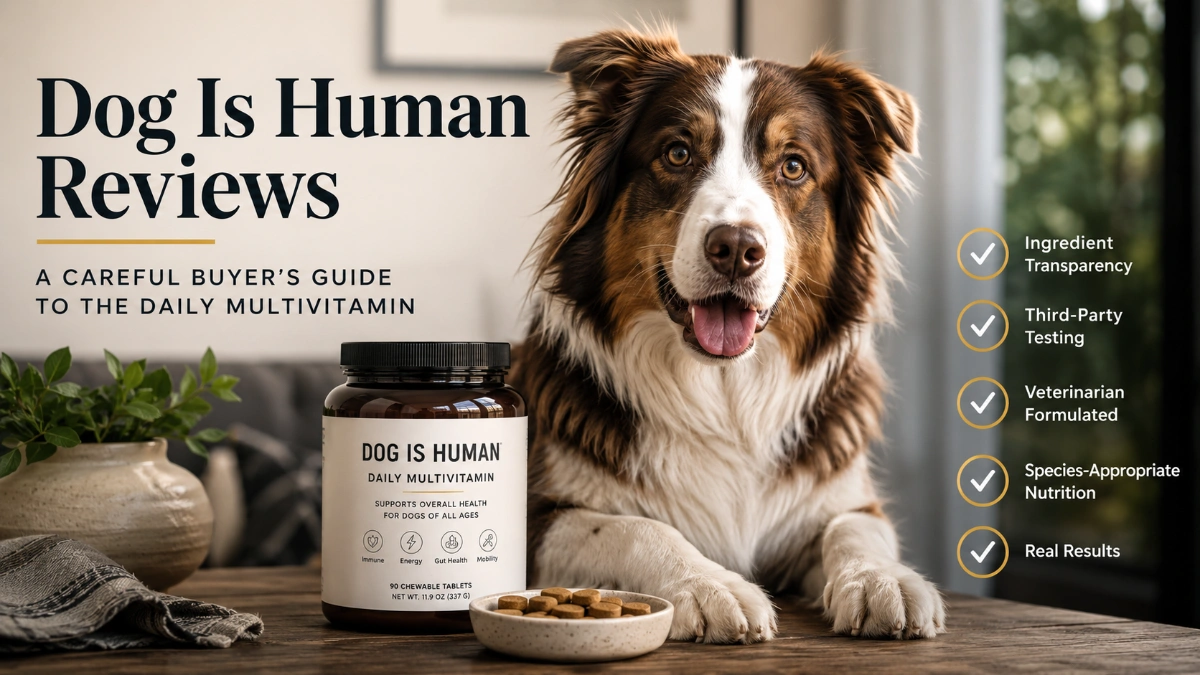
Dog is Human Reviews: 7 Essential Facts Before You Buy What Dog Is Human sells Dog Is Human markets DM-01 as a daily multivitamin soft chew. The brand describes it as vet-formulated and says it is intended to support skin and coat, hips and joints, heart health, gut and digestion, and immune health. That positioning […]
Dog is Human Reviews: 7 Essential Facts Before You Buy
What Dog Is Human sells
Dog Is Human markets DM-01 as a daily multivitamin soft chew. The brand describes it as vet-formulated and says it is intended to support skin and coat, hips and joints, heart health, gut and digestion, and immune health.
That positioning explains why dog is human reviews often focus on broad “everyday wellness” goals rather than a single condition. Still, a manufacturer’s intended-use language is not the same as evidence that every dog will benefit.
The brand also uses terms such as “human-grade,” natural flavours, and third-party tested. Those details may matter to some buyers, but they do not on their own establish that the chew is necessary, superior to alternatives, or appropriate for an individual dog.
What reviews can tell you
The most useful way to read dog is human reviews is to separate purchase experience from health outcomes. Brand-hosted testimonials can help you understand whether dogs tend to accept the chew and what owners say they noticed, while independent review platforms may be more useful for checking delivery, subscription, and customer-service patterns.
Dog Is Human’s own review page includes customer reports of perceived improvements involving coat appearance, itching, mobility, energy, digestion, and service. Those accounts are relevant as individual experiences, but they cannot confirm that the chew caused the change.
Independent search results also show mixed feedback: some buyers describe positive changes, while others report no obvious difference or an unwanted reaction. That variation is unsurprising with wellness supplements, because an owner’s observation can overlap with diet changes, seasonality, grooming, activity, medication, and the natural course of a problem.
| Source type | Best use | Important limitation |
| Brand testimonials | Check reported palatability and owner impressions | The brand controls the page and testimonials do not prove effectiveness |
| Independent review platforms | Look for patterns in checkout, delivery, subscription, and support | Ratings cannot diagnose a dog’s problem or prove a treatment effect |
| Editorial reviews | Compare product positioning and buyer considerations | Treat personal impressions as opinion unless independent evidence is supplied |
| Veterinary nutrition guidance | Decide whether a supplement fits the dog’s total diet and health context | It cannot predict an individual dog’s response |
The diet question matters
Before buying based on dog is human reviews, check the dog’s main food. FDA says a product with a nutritional-adequacy statement using “complete and balanced” is intended to serve as a pet’s sole diet, whereas treats, snacks, and supplements are typically not intended to be complete and balanced.
AAFCO (Association of American Feed Control Officials) similarly explains that a complete food provides required nutrients and a balanced food provides them in appropriate ratios for the stated life stage or condition. Supplements are generally intended to be fed in addition to a complete diet, not instead of one. [LE-009]
That does not mean every supplement is unnecessary. It means the decision should start with the dog’s whole diet, life stage, body condition, and reason for considering a chew. A product that sounds comprehensive may still be a poor substitute for investigating persistent symptoms or correcting a dietary problem.
When to ask a veterinarian
Use extra care with dog is human reviews if your dog has a diagnosed condition, follows a prescription diet, takes regular medication, is pregnant or nursing, is still growing, or has ongoing symptoms. A veterinarian can assess whether a supplement is relevant and whether the current food already meets the dog’s needs.
Persistent itching, hair loss, recurrent ear trouble, diarrhoea, vomiting, appetite changes, unexplained weight change, pain, or reduced mobility deserve assessment rather than a trial-and-error supplement response. A chew may be part of a broader plan, but it should not delay diagnosis.
If your veterinarian approves a trial, introduce only one new product at a time and follow the label. Keeping the rest of the diet stable makes it easier to notice changes in appetite, stool, skin, energy, or behaviour.
How to judge value
dog is human reviews can help with perceived palatability and customer experience, but value comes down to fit and cost per day. Use this calculation:
Cost per day=current container pricenumber of daily servings\text{Cost per day} = \frac{\text{current container price}}{\text{number of daily servings}}Cost per day=number of daily servingscurrent container price
Then compare the result with your dog’s recommended serving, the ingredient list, the specific goal you are trying to address, and the current purchase terms. Prices, formulas, subscription offers, and guarantees can change, so verify them on the official product and policy pages immediately before ordering.
A product is more likely to feel worthwhile when:
- Your dog has a clearly defined, veterinarian-approved reason to use it.
- The current label suits your dog’s age, size, diet, and ingredient sensitivities.
- Your dog willingly eats the chew.
- You are comfortable with the verified per-day cost and any subscription terms.
- You have a simple way to assess whether it is helping.
A practical decision checklist
- Identify the reason for considering a daily supplement rather than relying on a general wellness promise.
- Confirm that the main food is labelled for your dog’s species and life stage, and read its nutritional-adequacy statement.
- Review the current Dog Is Human label for ingredients, serving instructions, cautions, and flavour sources.
- Ask a veterinarian first if your dog has symptoms, a condition, medication use, a prescription diet, or a special life stage.
- If approved, avoid changing food, treats, and supplements all at once.
- Track the starting concern and reassess if it persists, worsens, or is accompanied by other changes.
Bottom line
The best dog is human reviews provide a useful signal about customer experience and whether owners feel the product suited their dogs. They are not a substitute for clinical evidence, a nutritional assessment, or veterinary diagnosis.
Dog Is Human can be a reasonable option for owners who have a specific, veterinarian-supported reason to add a daily chew and who verify the current label and purchase terms. It is a weaker choice when the goal is to self-manage unexplained symptoms or replace a complete diet with a supplement.
Frequently Asked Questions
Dog Is Human’s daily multivitamin is marketed as a supplement in soft-chew form. Supplements are generally intended to be fed alongside a complete diet rather than used as a dog’s sole food.
No. Reviews can describe owner experiences, chew acceptance, service, and perceived changes, but they cannot prove that the supplement caused a health outcome.
Not automatically. A food labelled complete and balanced is intended to provide nutritional adequacy for the listed life stage when fed as directed. A veterinarian can help decide whether an added supplement makes sense for a specific dog.
Check the current ingredient list, serving guidance, cautions, per-day cost, subscription conditions, and refund terms. These commercial details can change over time.
Persistent itching, digestive upset, weight change, pain, or other ongoing signs warrant veterinary assessment. A supplement should not replace identifying the cause.
If your veterinarian approves it, keep other diet changes to a minimum and note the start date, serving amount, appetite, stool, skin, coat, energy, and the original concern.