





The sphere volume formula is V=43r3, where V represents volume, r is the radius, and π is approximately 3.14159. To calculate the volume, cube the radius, multiply by pi, and then multiply by four-thirds. Your answer shows how much three-dimensional space is enclosed by the sphere and must be expressed in cubic units. This equation […]
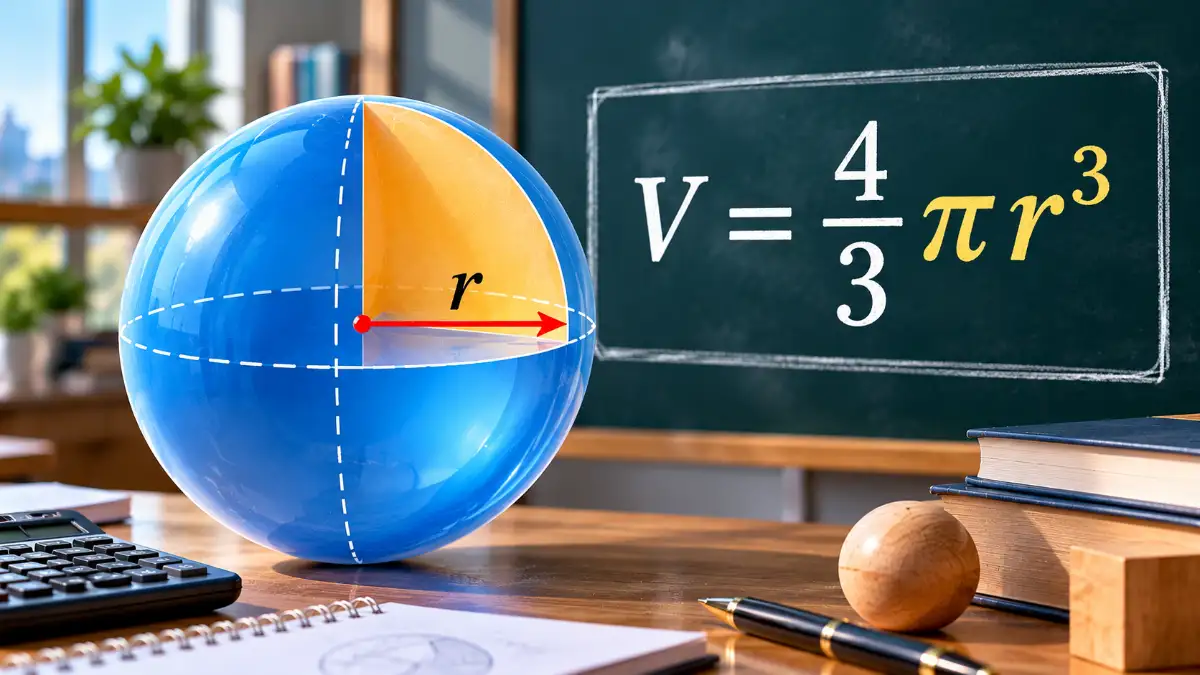
The sphere volume formula is V=43r3, where V represents volume, r is the radius, and π is approximately 3.14159. To calculate the volume, cube the radius, multiply by pi, and then multiply by four-thirds. Your answer shows how much three-dimensional space is enclosed by the sphere and must be expressed in cubic units.
This equation is commonly used in school geometry problems and calculations involving spherical objects. You can use it whether a question provides the radius or the diameter, although the first step differs slightly.
What Is the Volume of a Sphere?
A sphere is a perfectly round surface whose points are equally distant from a central point. In everyday geometry, the term is also used when discussing the solid region enclosed by that surface.
The volume measures the space inside that region.
For example, imagine a solid ball and a flat circle. The circle has area, measured in square units, while the ball occupies three-dimensional space, measured in cubic units.
If the radius is measured in centimeters, the volume is expressed in cubic centimeters (cm³).
A real ball might not be perfectly spherical. However, the formula can still give a useful approximation when its shape closely resembles a mathematical sphere.
Understanding the Sphere Volume Equation
The standard equation is:
\[ \boxed{V=\frac43\pi r^3} \]
| Symbol | Meaning |
| V | Volume enclosed by the sphere |
| r | Radius, measured from center to surface |
| Approximately 3.14159 | |
| r3 | Radius multiplied by itself three times |
| 4/3 | Constant multiplier in the equation |
The radius has a particularly important role because it is cubed.
Doubling a sphere’s radius makes its volume eight times greater. Tripling the radius makes the volume 27 times greater.
This explains why two balls with slightly different diameters can have noticeably different volumes.
How to Calculate Sphere Volume in 5 Steps
Consider a sphere with a radius of 3 centimeters.
Step 1: Identify the Radius
The radius is the distance from the sphere’s center to its outer surface.
For this example:
r=3cm
If you know only the diameter, divide it by two to obtain the radius.
Step 2: Cube the Radius
Cubing means multiplying the radius by itself three times.
r3=333=27
Do not confuse the third power with squaring. Volume calculations require three dimensions.
Step 3: Multiply by Pi
Multiply the cubed radius by .
27=27
Using the calculator’s pi key generally provides a more precise answer than rounding pi to 3.14 early.
Step 4: Multiply by Four-Thirds
Now complete the equation.
V=4327
V=36
Step 5: Add the Correct Units
The exact answer is 36 cubic centimeters.
Rounded to two decimal places:
\[ \boxed{V\approx113.10\text{ cm}^3} \]
Always check whether the question requests an exact answer or a rounded decimal.
Three Worked Sphere Volume Examples
Different measurements require slightly different approaches, but the underlying calculation remains the same.
Example 1: A Radius of 5 Centimeters
Suppose a sphere has a radius of 5 cm.
V=43(5)3
Since 53=125:
V=5003
Therefore:
\[ \boxed{V\approx523.60\text{ cm}^3} \]
This is the volume enclosed by a perfect sphere of that radius.
Example 2: A Diameter of 12 Inches
The diameter is twice the radius, so first divide by two.
r=122=6in
Substitute the radius:
V=43(6)3
V=288
\[ \boxed{V\approx904.78\text{ in}^3} \]
The most common error here is substituting the diameter directly into the radius-based equation.
Example 3: A Decimal Radius
A sphere has a radius of 2.5 meters.
V=43(2.5)3
V=1256
\[ \boxed{V\approx65.45\text{ m}^3} \]
Decimal measurements do not require a different equation. Keep enough precision during the calculation and round only at the end.
How to Find Volume Using Diameter Directly
There is a shorter approach when a problem supplies diameter instead of radius.
Since:
r=d2
Substituting into the standard equation gives:
V=43d23
Simplifying:
\[ \boxed{V=\frac{\pi d^3}{6}} \]
Here, d represents the diameter.
| Known measurement | Equation |
| Radius | V=43r3 |
| Diameter | V=d36 |
Either equation produces the same result when you use the correct variable.
Quick Reference Table
These rounded values can help you check calculations.
| Radius | Approximate volume in corresponding cubic units |
| 1 | 4.19 |
| 2 | 33.51 |
| 3 | 113.10 |
| 4 | 268.08 |
| 5 | 523.60 |
| 6 | 904.78 |
| 10 | 4,188.79 |
A radius of 10 units produces 1,000 times the volume of a radius of 1 unit, not merely ten times.
This relationship is useful when checking whether a calculated answer is reasonable.
Common Mistakes and How to Avoid Them
Even a simple formula can produce an incorrect answer if the measurements are misunderstood.
Confusing radius with diameter: Divide the diameter by two before using the radius-based equation.
Using the wrong exponent: Sphere volume uses r3, while sphere surface area uses r2.
Omitting the four-thirds multiplier: Pi multiplied by the cubed radius is not sufficient.
Forgetting cubic units: Write cm³, in³, m³, or whichever unit matches the measurement.
Rounding too early: Keep intermediate values precise to reduce avoidable numerical error.
A final reasonableness check can catch many mistakes before you submit your solution.
What If You Know the Volume but Need the Radius?
Some geometry problems work backward.
Starting with:
V=43r3
Rearrange the equation:
r3=3V4
Then take the cube root:
\[ \boxed{r=\sqrt[3]{\frac{3V}{4\pi}}} \]
For example, if the volume is 36 cm³:
r=327=3cm
This reverse calculation helps when a question gives the volume and asks for a sphere’s dimensions.
Read more: Sphere Volume Formula
Frequently Asked Questions
What is the formula for the volume of a sphere?
The formula is V=43r3. It calculates the space enclosed by a sphere using its radius.
How do I calculate sphere volume from the diameter?
Use V=d3/6, where d is the diameter. You can also divide the diameter by two and use the standard equation.
What is the volume of a sphere with radius 3 cm?
Its exact volume is 36 cm³, approximately 113.10 cm³.
Why do I cube the radius?
The volume of a similar three-dimensional shape scales with the cube of its linear dimensions.
What if the radius is a decimal?
Use the decimal directly. Cube it, multiply by pi and four-thirds, and round the final result as required.
What happens if the radius doubles?
The volume becomes eight times larger because 23=8.
Is sphere volume measured in square units?
No. Volume uses cubic units. Square units are used for surface area.
Can I calculate the radius from the volume?
Yes. Rearrange the equation to r=33V/(4), then substitute the known volume.
Can a calculator solve sphere volume questions?
Yes. A scientific or online calculator can evaluate the formula. Check whether it expects radius or diameter before entering a measurement.