







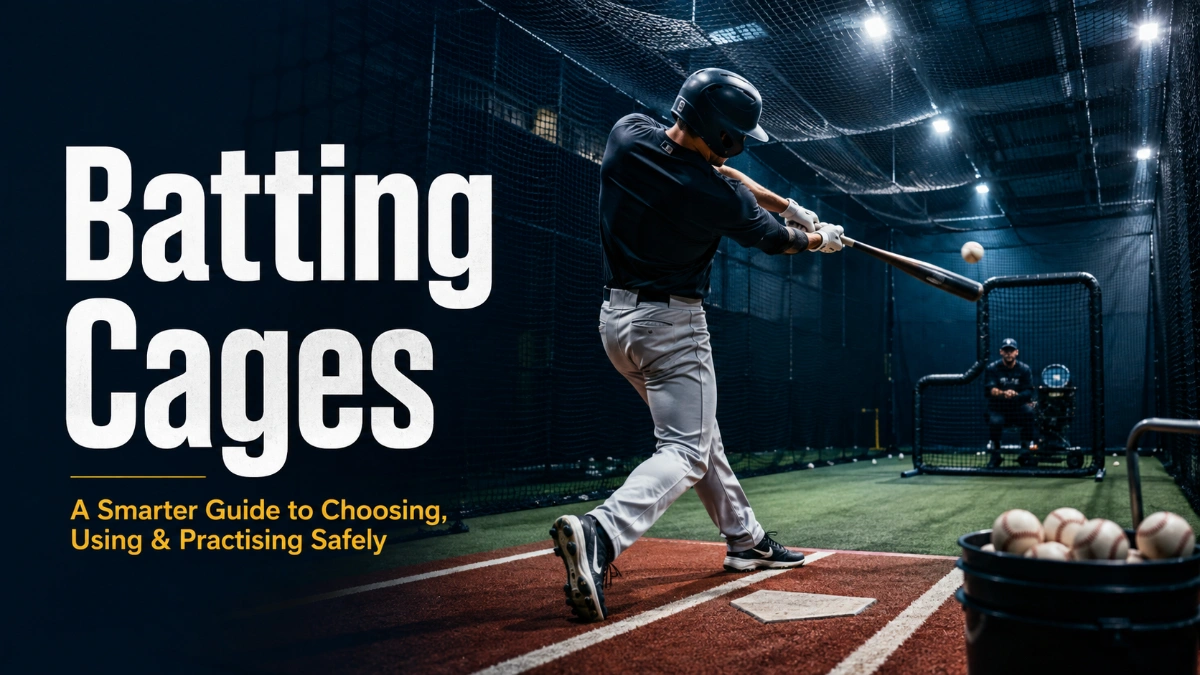
Batting Cages: How to Choose the Right Facility, Setup & Practice Session The important point is that not every cage is designed for every player or every type of practice. Batting Cages: What They Are and How to Choose the Right One. Batting cages provide a controlled environment for practising hitting without requiring a full […]
Batting Cages: How to Choose the Right Facility, Setup & Practice Session
The important point is that not every cage is designed for every player or every type of practice.
Batting Cages: What They Are and How to Choose the Right One. Batting cages provide a controlled environment for practising hitting without requiring a full baseball or softball field. Depending on the facility, a cage may use a pitching machine, coach pitch, soft toss, or another approved practice setup.
A baseball hitter may need a different machine, ball type, speed range, or lane configuration than a fastpitch softball player. A younger player may also have different supervision and equipment requirements from an adult or experienced athlete.
The best batting cages are therefore not necessarily the closest or most expensive. The better choice is the facility that matches your sport, age, equipment, practice objective, available time, and the venue’s safety rules.
Before booking, confirm the facility’s current policies rather than relying on an old directory listing or assumption.
What Should You Look for in Batting Cages?
Start with the purpose of the session.
Are you trying to work on timing? Controlled contact? Pitch recognition? Repetition? A team practice? A first visit for a younger player?
Your answer determines which facility features matter most.
| What to check | Why it matters |
| Baseball, fastpitch softball, or slow-pitch availability | Ball and machine compatibility can differ |
| Pitching-machine setup | Determines the type of practice available |
| Speed settings | The hitter needs a manageable starting level |
| Ball type | Baseball and softball setups are not automatically interchangeable |
| Indoor or outdoor location | Weather, lighting, surface, and scheduling can affect the session |
| Lane length and configuration | The available space should suit the intended practice |
| Walk-in or reservation system | A suitable facility is not useful if no lane is available |
| Helmet requirements | Protective equipment rules vary by venue |
| Supervision rules | Particularly important for younger players |
| Machine-operation policy | Some facilities restrict who can adjust or operate equipment |
| Session length | Helps you plan realistic practice |
| Cancellation policy | Important if the session is booked in advance |
| Accessibility | Check accommodations before travelling |
A facility that clearly explains its equipment, rules, booking process, and restrictions is easier to evaluate than one with incomplete information.
1. Choose Batting Cages by Fit, Not Just Distance
Searching for batting cages near me is a useful starting point, but proximity should not be the only filter.
A nearby facility may not support the sport or practice format you need. Another location slightly farther away may have better equipment, more suitable speed settings, clearer supervision rules, or a booking time that actually works.
When comparing facilities, ask:
- Does the lane support baseball or softball?
- Is the setup intended for fastpitch, slow-pitch, or another format?
- Does the cage use a pitching machine?
- What speed range is available?
- Who is allowed to adjust the machine?
- What type of balls are provided?
- Is a helmet required?
- Are helmets available to borrow?
- Is adult supervision required?
- Does the facility require reservations?
- Are there age restrictions?
- What happens if equipment is unavailable or damaged?
These questions can prevent a common problem: arriving at a facility only to discover that the available lane cannot support the session you planned.
2. Understand the Main Types of Batting Cages
Not all batting cages serve the same purpose.
Baseball Batting Cages
Baseball cages generally use equipment intended for baseball practice. Depending on the venue, the setup may support different speed levels and practice objectives.
A baseball player should confirm:
- baseball compatibility;
- machine type;
- available speed settings;
- ball type;
- lane configuration;
- machine-operation rules.
Do not assume that a facility advertising a generic “batting cage” automatically supports every baseball setup.
Softball Batting Cages
Softball requires additional attention to ball and machine compatibility.
Fastpitch and slow-pitch softball are different practice environments, so ask the facility exactly which format its lane supports.
For fastpitch players, confirm:
- softball compatibility;
- machine type;
- available settings;
- ball size/type used by the facility;
- lane availability;
- reservation requirements.
Indoor Batting Cages
Indoor batting cages can provide a more controlled practice environment when weather or daylight affects outdoor facilities.
Potential advantages include:
- predictable access;
- reduced weather disruption;
- consistent lighting;
- scheduled sessions;
- year-round availability where offered.
However, indoor does not automatically mean better. Equipment condition, machine setup, lane availability, rules, and the quality of the practice environment still matter.
Outdoor Batting Cages
Outdoor cages can be a practical choice when the weather, lighting, surface, equipment, and schedule are suitable.
Before travelling, check whether:
- the facility is operating that day;
- the lane is available;
- weather affects bookings;
- lighting is adequate;
- the surface is usable;
- the machine setup matches your needs.
The right choice is the one that provides the conditions required for your specific practice session.
3. Check the Pitching Machine Before You Book
The pitching machine is one of the most important parts of many batting cages.
However, machine specifications alone do not tell you whether a lane is appropriate.
Check:
- Machine type — Find out what kind of machine the facility uses.
- Speed options — Ask what settings are actually available.
- Adjustment rules — Some venues restrict who may change machine settings.
- Ball compatibility — Confirm that the machine and supplied balls are appropriate for your sport.
- Operator requirements — Find out whether staff or an adult must operate the machine.
- Condition — Do not use equipment that appears damaged or malfunctioning.
For younger players in particular, the facility’s supervision and machine-operation rules should take priority over convenience.
Little League’s published Safety Code, for example, states that pitching machines used in its setting must be in good working order and operated by adult managers or coaches. It also requires protective NOCSAE helmets for batters during practices and games under its rules.
That does not mean every commercial batting facility follows Little League rules. It means Little League provides a useful example of why machine operation, equipment condition, and protective equipment should be treated seriously.
4. Batting Cage Safety Comes Before Speed
A faster machine is not automatically a better practice session.
For a first visit or unfamiliar setup, begin with a level the hitter can control safely and comfortably. Increase difficulty only when the hitter remains balanced and the facility permits the adjustment.
Basic batting-cage safety habits
- Wear the helmet required by the facility or league.
- Check equipment before use.
- Follow posted cage instructions.
- Keep gates closed whenever the facility requires them to be closed.
- Keep waiting players and spectators outside the active hitting area.
- Never swing a bat outside the designated hitting area.
- Follow the facility’s machine-operation rules.
- Do not bypass protective screens or gates.
- Stop using equipment that appears damaged or unsafe.
- Tell staff about damaged netting, cords, machines, balls, or surfaces.
- Follow all age and adult-supervision requirements.
Little League’s safety guidance specifically emphasizes equipment inspection, proper fit, protective helmets, and safe pitching-machine operation.
NOCSAE also maintains dedicated baseball and softball standards for batter helmets, including standards for newly manufactured and recertified helmets.
For that reason, a helmet should not simply be treated as optional equipment unless the specific facility and applicable rules say otherwise.
5. How to Check a Batting Helmet
If a facility provides helmets, ask what type and size options are available before your session.
If you bring your own, inspect it before use.
Look for:
- visible cracks;
- obvious damage;
- missing or deteriorated padding;
- loose or damaged components;
- other signs that the helmet may no longer be suitable for use.
Little League’s equipment-inspection guidance says batting helmets used in its setting should carry the NOCSAE symbol and be free of cracks or visible damage, with internal padding intact.
Rules differ between leagues and facilities, so always follow the requirements that apply to your particular session.
6. Confirm the Facility Details Before You Travel
Local facility information can change.
Hours, prices, available lanes, equipment, age requirements, waiver policies, and booking rules should therefore be confirmed through the facility’s current information before you leave.
Quick booking checklist
- Confirm the sport format.
- Confirm the ball type.
- Ask what pitching or machine setup is available.
- Check available speed settings.
- Confirm who may operate or adjust the machine.
- Check helmet requirements.
- Ask whether helmets are provided.
- Check age and supervision requirements.
- Confirm session length.
- Check arrival instructions.
- Ask whether a waiver is required.
- Confirm payment requirements.
- Review cancellation rules.
- Check footwear restrictions.
- Ask about accessibility needs.
- Confirm spectator rules.
- Verify that the lane is actually available.
A few minutes of checking can prevent an unnecessary trip.
7. How Much Do Batting Cages Cost?
There is no single universal price for batting cages.
The cost can depend on:
- location;
- session length;
- machine type;
- number of players;
- private versus shared use;
- indoor versus outdoor operation;
- membership status;
- team or group rental;
- coaching or instruction;
- equipment rental;
- peak versus off-peak scheduling.
Because facility pricing changes frequently, it is better to treat published prices as venue-specific rather than presenting one national “average” as a universal fact.
Before booking, ask:
What is included in the advertised price?
A low headline price may not include equipment rental, additional time, private-lane access, or other charges.
8. Indoor vs. Outdoor Batting Cages: Which Is Better?
Neither is automatically better.
| Factor | Indoor | Outdoor |
| Weather disruption | Usually lower | Potentially higher |
| Lighting | Generally controlled | Depends on facility/time |
| Surface | Usually controlled | Depends on conditions |
| Seasonal access | May be more predictable | Can vary |
| Practice environment | More controlled | More dependent on conditions |
| Best choice | Consistent access | Suitable conditions and schedule |
The decision should be based on the practice objective rather than a blanket assumption that indoor or outdoor is superior.
For example, an outdoor facility with suitable equipment and reliable scheduling may be a better choice than an indoor location with an unsuitable machine.
9. Turn Batting Cage Time Into Purposeful Practice
A cage session does not need to be complicated.
Choose one main objective before you start.
Possible goals include:
- controlled contact;
- timing;
- balance;
- seeing the ball earlier;
- working on a particular pitch location;
- repeating a specific swing focus.
Trying to hit every pitch as hard as possible is not the only way to use cage time.
A controlled session can provide repeated opportunities to work on one skill while keeping the difficulty appropriate.
Sample 25-Minute Batting Cage Session
This is an adjustable example rather than a prescribed training plan.
1. Prepare — 3 to 5 minutes
- Check the helmet.
- Confirm the lane is clear.
- Review the facility’s machine process.
- Take permitted dry swings.
- Make sure everyone understands the venue’s safety rules.
2. Find the rhythm — 8 minutes
Use a manageable setting and focus on balanced, controlled contact.
3. Work one objective — 8 minutes
Choose one focus, such as:
- hitting through the middle;
- maintaining balance;
- recognising pitches outside the intended zone;
- making consistent contact.
4. Adjust — 3 to 5 minutes
Increase difficulty only if the hitter remains in control and the facility’s rules allow the change.
5. Review — 1 to 2 minutes
Identify:
- one thing that worked; and
- one focus for the next session.
The purpose is not to turn a pitching machine into a substitute for every form of baseball or softball practice. A machine can provide repetition, but it does not reproduce every aspect of live pitching, including changing pitch movement, decision-making, and game pressure.
10. What Batting Cages Can—and Cannot—Replicate
Batting cages are useful because they allow repeated practice in a controlled environment.
But their limitations matter.
A fixed machine or feed can help with:
- repeated timing work;
- contact practice;
- swing repetition;
- controlled pitch recognition exercises;
- working within a chosen difficulty range.
It cannot perfectly reproduce:
- every live-pitch movement;
- changing release points;
- game pressure;
- every tactical situation;
- the full range of decisions made against live pitching.
That is why cage practice can be one component of a broader practice routine rather than the only form of training.
When available and appropriate, cage work can be combined with coached practice, live pitching, field work, and other sport-specific activities.
11. When Should You Choose Another Batting Cage?
Do not force a session simply because you have already travelled to the facility.
Consider another option if the venue cannot provide:
- the required ball type;
- an appropriate machine setup;
- a usable speed range;
- safe equipment;
- required supervision;
- an appropriate lane;
- reasonable access for the planned session.
This is especially important for younger players and first-time visitors.
If a lane, machine, net, surface, or other equipment appears damaged or unsafe, stop and notify facility staff rather than attempting to work around the problem.
12. Batting Cages for Different Practice Goals
The best facility can change depending on what you are trying to accomplish.
| Practice goal | Prioritise | Confirm first |
| First youth visit | Clear rules, supervision, suitable helmet, manageable setting | Age policy, equipment, operator rules |
| Baseball timing | Baseball-compatible setup and controllable speed | Machine availability, ball type, lane rules |
| Fastpitch softball | Fastpitch-compatible equipment | Softball machine, ball compatibility, reservation |
| Reliable routine practice | Predictable conditions and convenient sessions | Hours, booking model, cancellation policy |
| Team practice | Multiple lanes and coach-friendly rental process | Group limits, supervision, booking window |
| Self-service session | Facility-approved process and machine access | Age limits, operator policy, emergency process |
| Skill-focused repetition | A setup that matches the specific objective | Machine settings and session restrictions |
This is why “best batting cages” is not always a universal ranking. The right choice depends on the player and purpose.
13. How to Find Batting Cages Near You
A local search can begin with:
- map services;
- recreation facilities;
- baseball and softball training centres;
- sports complexes;
- dedicated cage directories;
- local leagues and training organisations.
Directories can help identify possible facilities, but their information should be treated as a starting point.
Before travelling, verify the facility’s current:
- hours;
- address;
- booking availability;
- pricing;
- equipment;
- age requirements;
- safety rules;
- machine settings;
- cancellation policy.
A search result is not the same thing as confirmed availability.
14. A Simple Batting Cage Decision Framework
If you are comparing several batting cages, use this five-step process:
Step 1: Define the practice goal
Know whether you want timing, contact work, repetition, team practice, or another specific objective.
Step 2: Match the sport
Confirm baseball, fastpitch softball, slow-pitch softball, or another supported format.
Step 3: Match the equipment
Check the machine, ball type, speed settings, lane configuration, and operator requirements.
Step 4: Check safety and access
Confirm helmets, supervision, gates, equipment condition, age rules, and accessibility.
Step 5: Confirm the booking
Verify the current time slot, price, session length, payment requirements, and cancellation policy.
If a facility passes all five steps, it is much more likely to suit the planned session.
Batting Cages: Final Checklist Before You Go
Before leaving home, ask:
Does the facility support my sport?
Is the machine suitable for my intended practice?
Is the required ball type available?
Do I know the speed-setting rules?
Do I know who can operate the machine?
Do I have the required helmet or know whether one is provided?
Have I checked age and supervision rules?
Is my lane actually booked or available?
Have I checked the facility’s current rules and cancellation policy?
If the answer to these questions is yes, you have removed many of the avoidable problems that can turn a planned practice session into a wasted trip.
Read more: Batting Cages: Your Visit-Ready Guide to 6 Safer, Smarter Choices
Frequently Asked Questions
Batting cages provide a controlled space for practising hitting. Depending on the facility, they may support baseball or softball practice using pitching machines, coach pitch, soft toss, or another approved setup.
No. Facilities can differ in their ball types, machine configurations, speed settings, and supported sports. Always ask the venue whether the selected lane supports your specific baseball or softball format.
It depends on the facility. Some accept walk-ins, while others use reservations, memberships, team rentals, or timed lane bookings. Check the facility’s current policy before travelling.
Start with local map services, recreation facilities, sports complexes, training centres, and cage directories. Then verify the facility’s current hours, equipment, pricing, availability, and safety rules directly with the venue.
Confirm the sport format, machine or pitching setup, speed options, ball type, booking rules, helmet requirements, equipment availability, age policy, supervision rules, waiver requirements, and cancellation terms.
A beginner should start at a setting they can manage safely and comfortably. Difficulty can be increased gradually when balance and control remain appropriate and the facility permits the adjustment.
There is no single beginner speed that is correct for every player.
Follow the specific facility’s age and supervision policy. Younger players may be subject to additional supervision requirements, particularly when pitching machines are involved.
Little League’s safety guidance, for example, requires pitching machines in its setting to be operated by adult managers or coaches.
Use the helmet required by the facility or applicable league. Baseball and softball batter helmets are covered by NOCSAE performance standards, and applicable league rules may specify additional requirements.
Inspect it for visible cracks, obvious damage, missing or deteriorated padding, and other signs of deterioration. If equipment appears unsafe, do not use it and follow the facility’s process for reporting or replacing it.
Little League’s equipment guidance specifically addresses visible helmet damage and deteriorated padding in its setting.
Neither is automatically better. Indoor cages may provide more predictable access when weather or daylight is a concern, while outdoor cages can work well when their equipment, surface, lighting, weather, and schedule meet the player’s needs.
They can be useful for controlled repetition, timing, and contact work. However, pitching machines do not reproduce every element of live pitching or game conditions, so cage work is best understood as one part of broader practice.
Do not use equipment or an area that appears damaged, wet, or unsafe. Notify staff and follow the facility’s posted safety process. If the problem cannot be resolved appropriately, choose another facility.
They can be, provided the facility offers enough lanes, appropriate equipment, group bookings, and supervision arrangements. Confirm group limits and booking requirements before arriving.
Some facilities support fastpitch softball, but not all do. Confirm that the lane, machine, ball type, speed settings, and reservation system are designed for fastpitch practice before booking.