






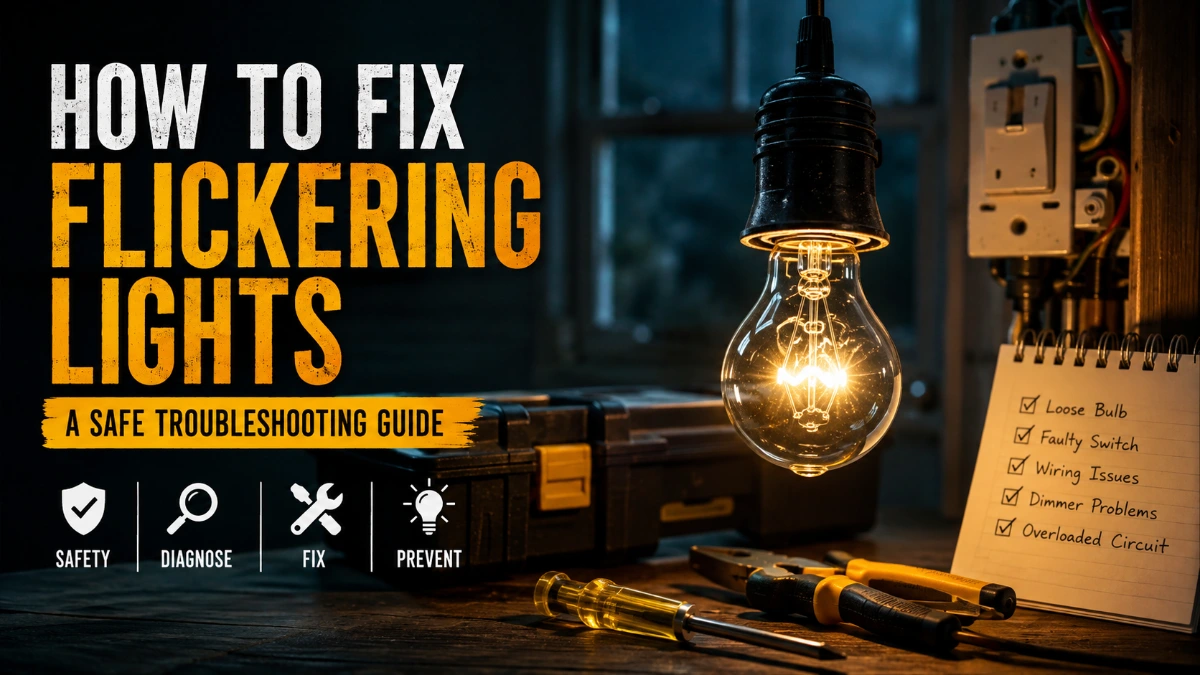
How to Fix Flickering Lights: Safe Checks and When to Call an Electrician Flickering lights are often caused by a loose or failing bulb, an LED bulb that does not work properly with its dimmer, or a problem confined to one fixture. Start with the safe checks below; if lights flicker across multiple rooms or […]
How to Fix Flickering Lights: Safe Checks and When to Call an Electrician
Flickering lights are often caused by a loose or failing bulb, an LED bulb that does not work properly with its dimmer, or a problem confined to one fixture. Start with the safe checks below; if lights flicker across multiple rooms or you notice heat, buzzing, sparks, burning odours, or repeated breaker trips, stop and arrange professional help.
Start with a safety check
For basic how to fix flickering lights troubleshooting, turn the wall switch off before touching a bulb and let hot bulbs cool first. Do not remove a switch cover, open a fixture, handle exposed wiring, or work in an electrical panel unless you are qualified to do so.
The U.S. Consumer Product Safety Commission identifies dimming or flickering lights, buzzing sounds, overheated-plastic odours, hot switch plates or outlet covers, sparks, and repeatedly tripping breakers as electrical-system warning signs. A licensed electrician should assess these symptoms.
If you rent, report persistent flickering or any warning sign to your landlord or property manager rather than attempting electrical repairs yourself.
Match the symptom first
| Symptom | Safe first step | What the result suggests |
| One bulb flickers | Turn power off, then tighten or replace the bulb | A loose or failing bulb may be the cause |
| Flicker began after changing to LED | Check that the bulb is dimmable if used on a dimmer | A bulb-and-dimmer mismatch is possible |
| Only a dimmed light flickers | Check manufacturer compatibility information | LED/dimmer compatibility is model-specific |
| One fixture flickers with several bulbs | Stop after bulb-swap testing | The fixture, socket, switch, or its wiring needs professional assessment |
| Lights flicker with breaker trips, warm outlets, buzzing, or burning smell | Stop using the affected circuit | Treat it as an electrical safety issue |
| Lights flicker during wind or storm conditions | Do not touch service equipment | Contact the power company immediately |
This symptom-first approach to how to fix flickering lights prevents the common mistake of repeatedly replacing bulbs when the issue is actually in the dimmer, fixture, circuit, or incoming service.
1. Tighten the bulb
A poor bulb-to-socket connection can cause intermittent flickering. This is the first and lowest-risk step in how to fix flickering lights.
- Turn the wall switch off.
- Allow the bulb to cool if it has been on.
- Screw the bulb in gently until snug; do not force or overtighten it.
- Turn the light back on and observe it for several minutes.
If the flicker stops, the connection was likely the issue. If the bulb has cracked glass, a damaged base, scorch marks, or other visible damage, replace it rather than reinstalling it.
2. Replace the bulb correctly
If tightening does not solve the problem, install a new bulb that matches the fixture’s socket type and maximum wattage rating. Using a bulb with a wattage higher than the fixture permits can create an overheating hazard; CPSC guidance advises not using the fixture until the problem has been corrected.
To isolate the problem, try the suspect bulb in another suitable fixture and try a known-good bulb in the flickering fixture. If the flicker follows the bulb, replace the bulb. If a known-good bulb flickers only in the original fixture, do not dismantle the fixture — move to the professional-help guidance below.
3. Check LED and dimmer compatibility
For LED lighting, how to fix flickering lights often means checking compatibility rather than simply buying another bulb. A bulb must be marked dimmable when installed on a dimmer-controlled circuit, but that alone does not guarantee smooth operation.
Use this checklist:
- Confirm that the LED bulb is labelled dimmable.
- Check that the installed dimmer is intended for LED loads.
- Find the bulb or dimmer manufacturer’s compatibility list, when one is available.
- Compare the specific bulb or luminaire model with the dimmer model.
- If incompatibility is likely, use a listed compatible combination or have a qualified electrician replace the dimmer.
LEDVANCE notes that its suggested dimmer lists are product-specific, and ENERGY STAR material similarly describes compatibility testing for particular lamp-and-dimmer combinations.
4. Use a bulb-swap test
A bulb-swap test is the limit of safe homeowner diagnosis for a single flickering fixture. It is useful because it distinguishes a likely bulb issue from a fixture-related issue without opening the fixture.
- Turn off the light.
- Install a known-good, compatible bulb.
- Turn the light back on.
- If the known-good bulb flickers in that fixture, stop troubleshooting.
- Arrange for an electrician to inspect the fixture, socket, switch, and associated connections.
That distinction is central to how to fix flickering lights safely: a bulb can be replaced by the homeowner, but an intermittent connection inside a fixture or switch should be assessed by a professional.
5. Look for overload patterns
Do not assume a flickering light is isolated if it occurs with other electrical symptoms. The Electrical Safety Foundation International lists flickering, blinking, or dimming lights; frequently tripped breakers or blown fuses; warm or discoloured wall plates; buzzing; and burning odours among warning signs of an overloaded electrical system.
As a safe observation step, note whether flickering appears when a particular appliance is running and whether it affects one room or several. Do not repeatedly reset a breaker or use extension cords and multi-outlet adapters to work around a circuit problem. Have a qualified electrician evaluate recurring symptoms.
6. Escalate whole-home flickering
When lights in more than one room flicker at the same time, the cause is less likely to be a single loose bulb. How to fix flickering lights in this situation is mainly about choosing the right professional response, not attempting a repair yourself.
Call a licensed electrician promptly when the flickering is recurring or widespread, especially if you also notice:
- Warm or discoloured switches, outlets, or wall plates
- Buzzing, sizzling, crackling, sparks, or smoke
- A burning-plastic smell
- Breakers that trip or fuses that blow repeatedly
- A failed outlet, light, or circuit
These are recognised electrical-system hazard signals in CPSC safety guidance
7. Know when to call the utility
If lights flicker during wind or after storm damage, do not touch the meter, service drop, service entrance cable, or other utility equipment. CPSC says flickering that occurs with wind can result from bad contacts at the junction between the service-entrance cable and the service drop; it advises consumers not to attempt repairs and to contact the power company immediately.
Call emergency services as well if you see a downed power line, smoke, fire, or immediate danger. Keep clear of damaged lines and equipment.
What not to do
- Do not exceed the fixture’s maximum bulb wattage.
- Do not fit a non-dimmable LED bulb to a dimmer-controlled circuit.
- Do not open a switch, fixture, outlet, junction box, or electrical panel to chase an intermittent connection.
- Do not keep resetting a breaker that trips repeatedly.
- Do not ignore flickering with heat, burning smells, buzzing, sparks, or discolouration.
- Do not touch service equipment or overhead power lines.
Frequently asked questions
Yes. A loose bulb can make inconsistent contact with the socket. Turn the switch off, allow the bulb to cool, tighten it gently, and replace it if it is damaged or continues to flicker.
The bulb may not be dimmable, or the specific bulb-and-dimmer pairing may be incompatible. Check manufacturer compatibility information because LED dimmer performance can depend on the exact models used.
A single loose or failing bulb is often a straightforward issue. Flickering accompanied by hot outlets or switches, burning odours, buzzing, sparks, smoke, or repeated breaker trips is a safety concern that requires a licensed electrician.
Wind-related flickering can point to a poor connection where the service-entrance cable meets the utility service drop. Do not touch the equipment; contact the power company.
Only do so if you are properly qualified and local requirements allow it. For most homeowners, arranging a licensed electrician is the safer choice, particularly when the cause has not been confirmed.