







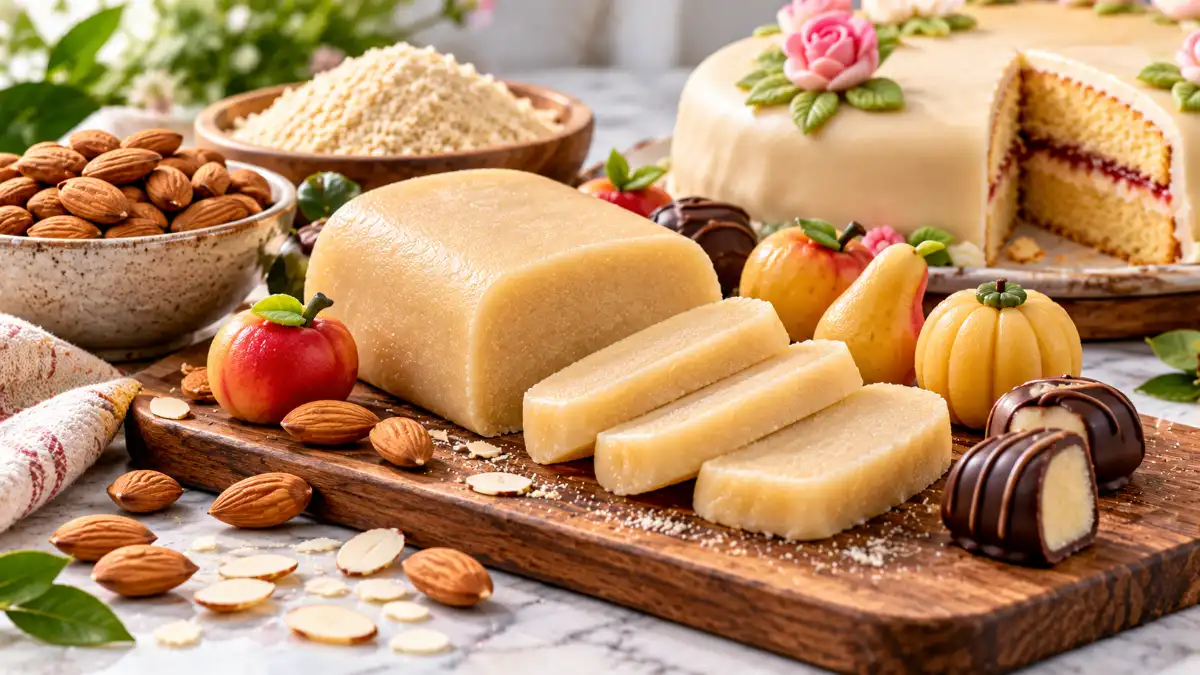
Marzipan is a sweet almond-based confection made primarily from finely ground almonds and sugar. It has a soft, dense texture that makes it easy to shape into candies, roll over cakes, or use in traditional desserts. Its flavor is distinctly nutty and sweet, although the intensity varies by recipe. If you’ve seen miniature edible fruits […]
Marzipan is a sweet almond-based confection made primarily from finely ground almonds and sugar. It has a soft, dense texture that makes it easy to shape into candies, roll over cakes, or use in traditional desserts. Its flavor is distinctly nutty and sweet, although the intensity varies by recipe. If you’ve seen miniature edible fruits in a candy shop or a smooth almond covering on a celebration cake, you may already be familiar with this classic confection. Understanding what it contains-and how it differs from almond paste-makes choosing the right baking ingredient much easier.
What Exactly Is Marzipan?
This traditional confection combines ground almonds and sugar into a smooth, flexible paste. Unlike loose almond flour or spreadable almond butter, the mixture holds together well enough to knead, roll, and sculpt.
Its versatility is one of its biggest advantages. Confectioners can transform the almond paste into miniature fruits, chocolate-covered candies, or detailed decorations. Bakers also use it as a cake covering or sweet filling.
It is particularly associated with European confectionery traditions, although it is widely available in the United States through baking suppliers, specialty food stores, and some supermarkets.
What Is It Made Of?
Almonds and sugar are the two essential ingredients. Beyond those basics, recipes can vary considerably.
Common additional ingredients include:
- Egg whites or pasteurized egg products
- Water or sugar syrup
- Almond extract
- Confectioners’ sugar
- Other permitted flavorings
Some preparations use cooked syrup and egg whites, while others are completely egg-free.
The proportion of almonds to sugar influences both taste and texture. A higher almond content generally gives the confection a stronger nutty flavor, although the almond variety and added flavorings also matter.
For example, King Arthur Baking’s homemade version uses almond flour, sugar, water, and egg white in a cooked preparation.
Commercial products may follow different formulas, so checking the ingredient label is the best way to know exactly what a particular product contains.
What Does Marzipan Taste Like?
The flavor is sweet, rich, and distinctly almond-like.
Its almond character may be subtle or surprisingly strong, especially when almond extract is included. Some varieties have a noticeable aromatic quality, while others taste primarily sweet with a mild nutty finish.
The texture is equally distinctive. It is generally smooth and dense with a slight chewiness. Because it contains finely ground nuts, there may also be a faint graininess rather than a completely silky feel.
Unlike almond butter, this confection is not intended to spread easily. Instead, it behaves more like a firm edible dough.
People who enjoy almond cookies, almond-filled pastries, or chocolate-covered nuts may also appreciate its flavor.
Marzipan vs. Almond Paste: What’s the Difference?
These two almond products contain similar basic ingredients, but they are not usually interchangeable in American recipes.
| Feature | Marzipan | Almond Paste |
| Main ingredients | Almonds and sugar | Almonds and sugar |
| Sweetness | Generally sweeter | Generally less sweet |
| Texture | Smooth and moldable | Often softer and coarser |
| Main purpose | Candy and decoration | Baking and fillings |
| Typical use | Cake covering, molded sweets | Cookies, pastries, cakes |
Almond paste is commonly incorporated into baked goods to add moisture and almond flavor. The sweeter confection is usually firm enough to retain its shape during decorative work.
The distinction is not identical in every country or product line. However, when an American recipe specifically calls for one ingredient, replacing it with the other without adjusting the recipe may affect the final texture and sweetness.
Food Network’s explanation of the two ingredients also highlights these practical differences.
Is It the Same as Fondant?
No. Although both ingredients can be used to cover cakes, their composition and flavor are quite different.
The almond-based version contains ground nuts, which give it a characteristic nutty taste. Rolled fondant is primarily a sugar-based icing designed to create a smooth decorative surface without the same natural almond flavor.
An almond layer may also be placed beneath another cake covering to add flavor and create a smoother finish.
Fondant is generally preferred when a specific decorative appearance is the main goal, while almond confectionery works especially well when its flavor complements the cake.
For anyone with a tree-nut allergy, the difference is especially important because traditional recipes contain almonds.
Where Is Marzipan Used?
Traditional Cakes
Battenberg cake is one well-known example. Its checkerboard-patterned sponge is traditionally wrapped in a layer of almond confectionery.
Swedish princess cake also commonly features a smooth, often green almond-based covering over layers of sponge and filling.
Handmade Candies
The paste can be shaped into small pieces, coated with chocolate, or formed into fruit-inspired sweets.
These colorful candies are particularly recognizable in traditional confectionery shops and holiday assortments.
Cake Decorations
Its flexible texture makes it suitable for flowers, animals, miniature vegetables, and sculpted figures.
Food-safe coloring can be added to create detailed and surprisingly realistic decorations.
Baked Breads and Pastries
Some versions of German stollen contain a sweet almond filling.
This creates a rich center that contrasts with the surrounding bread, dried fruit, and spices.
Where Did Marzipan Originate?
The history of this confection is complex, and its exact birthplace remains disputed.
Almond-and-sugar sweets developed across several culinary traditions. Spain, Italy, and Germany all have longstanding associations with similar preparations.
Toledo, Spain, has a particularly well-documented tradition. European Union documentation for Mazapán de Toledo refers to a recipe printed in Spanish in Toledo in 1525 and confectioners’ regulations approved in 1615.
These records demonstrate an important Spanish tradition, but they do not prove that the confection originated exclusively in Toledo.
Its history is better understood as part of a broader exchange of confectionery techniques, ingredients, and regional food traditions.
Is Marzipan Safe to Eat Without Cooking?
Commercial products sold as ready-to-eat confectionery can normally be eaten without additional baking, provided the package instructions indicate that they are ready for consumption.
Homemade preparations require more care.
Some recipes contain egg whites. If the mixture will be eaten without sufficient cooking, the FDA recommends using pasteurized eggs or pasteurized egg products to reduce risks associated with raw eggs.
Another important consideration is allergens. Traditional recipes contain almonds, which are tree nuts. People with tree-nut allergies should avoid almond-based versions unless advised otherwise by an appropriate healthcare professional.
Always check commercial packaging for ingredient lists, preparation instructions, and allergen information.
- Read more: Marzipan
Frequently Asked Questions
Is marzipan a candy or a baking ingredient?
It can be both. Marzipan is eaten as a sweet confection, but its moldable consistency also makes it useful for cake coverings, decorations, and some pastry fillings.
Why does marzipan taste so sweet?
Sugar is one of its main ingredients. The sweetness varies by recipe, but marzipan generally contains more sugar relative to almonds than typical American almond paste.
Can you eat marzipan straight from the package?
Yes, if the manufacturer identifies it as ready to eat. Check the package instructions, especially when purchasing specialty baking products.
Does every marzipan recipe contain eggs?
No. Some recipes include egg white, while others use syrup or different binding methods. Ingredient lists are the best way to determine whether a particular product contains eggs.
Is marzipan suitable for someone with a nut allergy?
Traditional marzipan is not suitable for someone allergic to almonds. It is made with ground almonds, which are classified as tree nuts.
Why do people make fruit shapes from marzipan?
Its texture is naturally suited to sculpting. Confectioners can shape, color, and decorate it to resemble miniature oranges, pears, peaches, and other fruits.
Can you substitute almond paste for marzipan?
Not in every recipe. Almond paste is generally less sweet and has a different texture. Some recipes allow substitutions with adjustments, but decorative work usually requires a more moldable product.
Does marzipan need to be refrigerated?
That depends on the recipe and product. Commercial packaging provides the appropriate instructions, while homemade preparations may require refrigeration.
What desserts are traditionally made with marzipan?
Examples include Battenberg cake, Swedish princess cake, molded marzipan candies, and Almond confection
-filled variations of stollen.