







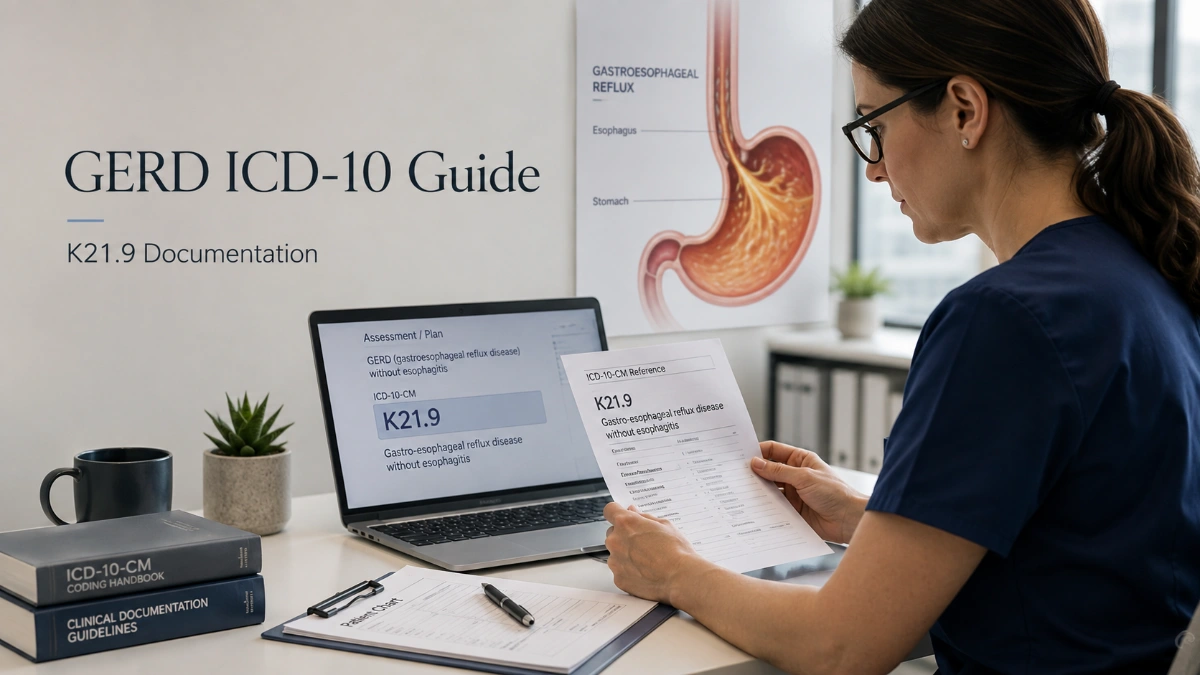
Gerd Icd 10: 4 Essential Steps for Accurate K21.9 Coding When reviewing gerd icd 10 coding, the fastest correct answer is not simply “use K21.9.” K21.9 applies when the provider documents gastro-esophageal reflux disease (GERD) without esophagitis. If GERD with esophagitis is documented, the K21.0x branch is used, with K21.00 for cases without bleeding and […]
Gerd Icd 10: 4 Essential Steps for Accurate K21.9 Coding
When reviewing gerd icd 10 coding, the fastest correct answer is not simply “use K21.9.” K21.9 applies when the provider documents gastro-esophageal reflux disease (GERD) without esophagitis. If GERD with esophagitis is documented, the K21.0x branch is used, with K21.00 for cases without bleeding and K21.01 for cases with bleeding.
In short, the primary ICD-10 code for GERD without esophagitis is K21.9. GERD with esophagitis is coded as K21.00 without bleeding or K21.01 with bleeding, depending on the documented condition.
Quick Answer: Which GERD Code Applies?
For a gerd icd 10 lookup, start with the documented diagnosis rather than symptoms alone.
| Documentation supported in the record | ICD-10-CM code | Code description |
| GERD without documented esophagitis | K21.9 | Gastro-esophageal reflux disease without esophagitis |
| GERD with documented esophagitis, without bleeding | K21.00 | Gastro-esophageal reflux disease with esophagitis, without bleeding |
| GERD with documented esophagitis and bleeding | K21.01 | Gastro-esophageal reflux disease with esophagitis, with bleeding |
K21.0 is the subcategory for GERD with esophagitis. Code selection continues to K21.00 or K21.01 based on documented bleeding status.
Start With Documentation
A reliable gerd icd 10 review begins by confirming that GERD is actually documented in the assessment or other documentation that can establish the diagnosis under the applicable coding rules.
Heartburn, regurgitation, acid-suppressing medication use, or another clinical clue should not automatically be converted into a confirmed GERD diagnosis.
The FY2026 ICD-10-CM Official Guidelines emphasize the importance of complete and accurate medical-record documentation. The guidelines state that the entire record should be reviewed to identify the reason for the encounter and the conditions treated.
Once GERD is established, determine whether esophagitis is documented. If GERD is documented without esophagitis, K21.9 is generally the appropriate diagnosis code. If GERD with esophagitis is documented, determine whether bleeding is also documented before selecting K21.00 or K21.01.
K21.9 vs K21.00 vs K21.01
The key gerd icd 10 distinction is the presence or absence of esophagitis and, when esophagitis is present, whether bleeding is documented.
K21.9: GERD Without Esophagitis
Use K21.9 when the medical record supports gastro-esophageal reflux disease without esophagitis.
K21.9 identifies the documented diagnosis, but it does not indicate:
- How severe the reflux symptoms are
- How long GERD has been present
- Which treatment should be used
- Whether a specific medication is appropriate
- Whether a procedure is medically necessary
The code is a diagnostic classification, not a complete clinical description of the patient.
K21.00: GERD With Esophagitis, Without Bleeding
Use K21.00 when the documentation specifically supports gastro-esophageal reflux disease with esophagitis, without bleeding.
The documented presence of esophagitis is the main distinction separating K21.00 from K21.9.
Symptom severity alone should not be used to infer esophagitis.
K21.01: GERD With Esophagitis, With Bleeding
Use K21.01 when documentation supports GERD with esophagitis and bleeding.
A reference to bleeding elsewhere in the medical record should not automatically be interpreted as GERD with esophagitis and bleeding. Code assignment should reflect the diagnosis and specificity actually supported by the documentation.
A Four-Step GERD Coding Review
Use this gerd icd 10 decision process before final code selection:
- Verify the documented diagnosis.
Confirm that GERD has been established in the medical record according to the coding rules applicable to the encounter. - Check for documented esophagitis.
When GERD is documented without esophagitis, K21.9 applies. - Check for bleeding when esophagitis is documented.
K21.00 represents GERD with esophagitis without bleeding, while K21.01 represents GERD with esophagitis with bleeding. - Do not fill documentation gaps by inference.
Follow ICD-10-CM conventions, setting-specific guidelines, and the organization’s approved clarification or provider-query process when additional specificity is necessary.
CMS likewise emphasizes that complete and consistent medical-record documentation is essential for accurate code assignment and reporting.
Do Not Code GERD From Symptoms Alone
A common GERD coding error is treating symptoms as though they automatically establish a confirmed gastroesophageal reflux disease diagnosis.
Heartburn and regurgitation may occur with GERD, but they do not by themselves establish that GERD has been diagnosed. They also do not establish the presence of esophagitis.
Similarly, treatment with a proton-pump inhibitor, H2 blocker, antacid, or another acid-suppressing medicine does not independently determine whether K21.9, K21.00, or K21.01 is appropriate.
Coding should reflect the documented diagnosis and the rules applicable to the care setting.
For example, outpatient coding rules address uncertain diagnoses differently from confirmed conditions. Coders should therefore follow the official setting-specific guidance rather than infer a diagnosis solely from symptoms, medication use, or test results.
Common GERD Coding Mistakes to Avoid
When selecting an ICD-10 code for GERD, avoid these common errors:
- Choosing K21.9 only because “GERD” appears somewhere in the chart. Review relevant documentation to determine whether esophagitis is also documented.
- Using K21.00 when GERD with esophagitis and bleeding is documented. K21.01 provides the more specific classification when supported.
- Assigning K21.01 because bleeding appears elsewhere in the record. The documentation must support GERD with esophagitis and bleeding.
- Stopping at K21.0. K21.0 is a subcategory; K21.00 and K21.01 provide the required bleeding distinction.
- Inferring esophagitis from severe heartburn. Symptom intensity alone does not establish esophagitis.
- Assuming medication confirms GERD. Medication use can provide clinical context but should not replace appropriate diagnosis documentation.
- Using the wrong ICD-10-CM year. Always confirm the code set applicable to the date of service.
Is K21.9 Billable and Valid in FY2026?
For FY2026, gerd icd 10 selection should use the code set applicable to the date of service.
K21.9 is a complete ICD-10-CM diagnosis code for gastro-esophageal reflux disease without esophagitis when documentation supports that diagnosis.
The CDC states that FY2026 ICD-10-CM codes apply to healthcare services provided through September 30, 2026. CMS also publishes the FY2026 ICD-10-CM files and the April 1, 2026 update applicable through September 30, 2026.
FY2027 begins on October 1, 2026, so encounters on or after that date should be checked against the FY2027 code set rather than relying automatically on the FY2026 files.
A valid diagnosis code does not by itself guarantee reimbursement. Coverage rules, medical necessity requirements, sequencing, payer edits, and other billing policies may still affect a claim.
What K21.9 Does Not Tell You
The gerd icd 10 code K21.9 identifies GERD without esophagitis. It does not:
- Grade symptom severity
- Show how frequently reflux occurs
- State how long GERD has been present
- Identify the underlying cause
- Specify a treatment plan
- Determine medication eligibility
- Guarantee insurance coverage
- Replace a clinical evaluation
This distinction matters because ICD-10-CM codes classify documented diagnoses. They are not complete descriptions of an individual’s health status.
Patients should not use a diagnosis code alone to self-diagnose or decide whether treatment is required. Persistent, worsening, or concerning gastrointestinal symptoms should be evaluated by a qualified healthcare professional.
Why Documentation Matters More Than Symptom Severity
The same gerd icd 10 decision process applies whether the patient reports occasional symptoms or significant discomfort: code selection must be supported by the medical record.
For example, severe heartburn does not automatically support K21.00 because symptom severity does not establish esophagitis.
Likewise, a history of gastrointestinal bleeding does not automatically support K21.01 unless the documentation establishes GERD with esophagitis and bleeding at the specificity represented by that code.
Diagnostic testing may contribute important clinical information, but ICD-10-CM assignment must still follow official coding conventions, documentation requirements, and rules applicable to the healthcare setting.
When the available documentation does not provide enough detail for a specific code, follow the organization’s approved provider-query or clarification procedure rather than assuming greater specificity.
Frequently Asked Questions
The code is K21.9, meaning gastro-esophageal reflux disease without esophagitis when the documentation supports that diagnosis.
The appropriate code depends on the documented diagnosis. K21.9 represents GERD without esophagitis. GERD with esophagitis is classified under K21.00 or K21.01, depending on whether bleeding is documented.
K21.9 describes GERD without esophagitis.
K21.00 describes GERD with esophagitis, without bleeding.
The presence of documented esophagitis is therefore the primary distinction between the two codes.
K21.01 means gastro-esophageal reflux disease with esophagitis, with bleeding.
Documentation should support both esophagitis and bleeding as part of the condition before this level of specificity is selected.
K21.0 is the subcategory for gastro-esophageal reflux disease with esophagitis. Code selection continues to K21.00 or K21.01, depending on the documented bleeding status.
Not from symptom severity alone.
The record needs to support GERD with esophagitis before K21.00 or K21.01 is selected.
No.
K21.9 identifies GERD without esophagitis. It does not classify the disease as mild, moderate, or severe.
Yes. K21.9 is a complete ICD-10-CM diagnosis code when documentation supports gastro-esophageal reflux disease without esophagitis.
Whether a claim is paid depends on additional factors such as coverage, medical necessity, sequencing, and payer requirements.
No. Medication use may provide clinical context, but it should not replace appropriate documentation of the diagnosis.
FY2027 ICD-10-CM codes take effect on October 1, 2026. The code set applicable to the actual date of service should always be verified.