






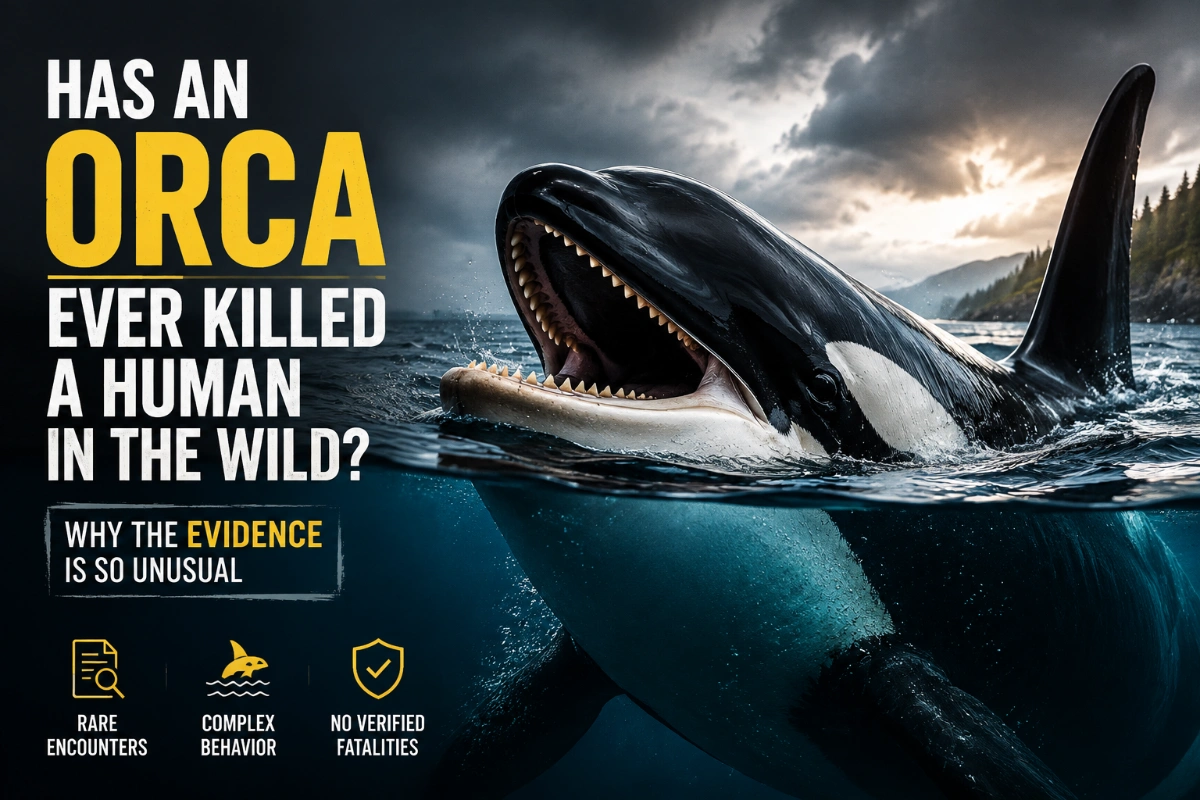
has an orca ever killed a human in the wild: 3 Powerful Evidence Insights The answer to has an orca ever killed a human in the wild is no confirmed fatal attack by a free-ranging orca on a person has been established in the documented historical record. That conclusion is based on available evidence, not […]
has an orca ever killed a human in the wild: 3 Powerful Evidence Insights
The answer to has an orca ever killed a human in the wild is no confirmed fatal attack by a free-ranging orca on a person has been established in the documented historical record. That conclusion is based on available evidence, not a claim that researchers can prove no such event could ever have occurred outside recorded history.
The more interesting question is why a predator capable of hunting large marine animals has no verified pattern of killing humans in the wild. Understanding that requires separating what scientists know about orca behavior from what they can only suggest.
Orcas are powerful predators, but their behavior is shaped by ecology, learned hunting traditions, population differences, and prey preferences. Those factors may help explain the unusual relationship between humans and wild killer whales, but no single explanation has been proven.
The documented record comes before the explanation
Before asking why wild orcas rarely harm humans, the evidence itself must be clear.
The documented record includes:
| Event type | Example | What the evidence shows |
| Wild human injury | Hans Kretschmer, Point Sur, California (1972) | A wild orca injured a person, who survived |
| Unverified historical account | Foxe Basin oral-history report | A possible fatal event was described but not confirmed |
| Captive fatal incident | Dawn Brancheau and Tilikum (2010) | Fatal human-orca incidents have occurred in captivity, not in the wild |
The difference between these categories is essential. A bite, a vessel interaction, and a fatal attack represent different claims that require different levels of evidence.
has an orca ever killed a human in the wild? What researchers can actually confirm
The question has an orca ever killed a human in the wild is answered most accurately through the standard of verification.
Current evidence has not established a confirmed wild-orca fatality involving a human. However, the historical record includes events that explain why the question continues to attract attention.
The best-known confirmed wild-human encounter is the 1972 Point Sur incident, where surfer Hans Kretschmer was bitten by a wild orca and survived. This case demonstrates that wild orcas can cause serious injury, but it does not show a pattern of predatory behavior toward humans.
Another frequently discussed account comes from Foxe Basin in Nunavut. Researchers documented Inuit oral histories describing a young man allegedly killed during a killer-whale ice entrapment event in the 1950s. The account remains historically significant, but it has not been verified with direct evidence.
This distinction matters because a reported event and a confirmed scientific record are not always the same thing.
Why a powerful predator does not automatically hunt humans
A common assumption is that an animal capable of killing large marine mammals should naturally view humans as possible prey.
However, predator behavior is not determined only by physical ability. Ecology and learned behavior also influence what animals hunt.
Different killer-whale populations have different diets and hunting traditions. Some groups specialize in fish, while others hunt marine mammals or other prey. These preferences are often learned socially within groups and passed through generations.
This means an orca’s ability to kill something does not automatically tell researchers whether that animal recognizes the same species as prey.
Prey specialization may help explain the pattern, but it is not the whole answer
Research on killer whales shows that populations can develop specialized feeding strategies. These traditions influence what animals they pursue and how they hunt.
That specialization may be one factor contributing to the absence of documented wild-orca human fatalities. For example, a population that has developed techniques for hunting a particular type of prey may not simply switch to a completely different target.
However, scientists cannot point to one proven reason why wild orcas have no established record of fatal human attacks.
Possible explanations involve several factors:
- differences among orca populations;
- learned hunting traditions;
- ecological conditions;
- limited opportunities for close human-orca encounters;
- the unusual nature of humans as potential prey.
The evidence supports these as possible contributing factors, not a single confirmed explanation.
has an orca ever killed a human in the wild? Human interactions show complexity, not simple friendliness
Wild orcas have displayed a variety of interactions with humans.
Scientific observations have recorded free-ranging orcas approaching divers and showing exploratory behaviors. Other research has documented cases where wild killer whales offered prey or objects to humans.
These examples show that interactions between humans and orcas can be complex. They do not prove that wild orcas are naturally friendly toward humans or that close encounters are always safe.
Interaction is not the same as trust, and curiosity is not the same as harmlessness.
Boat interactions are a separate question from human predation
Recent attention around Iberian orcas has created additional confusion.
Some killer whales have interacted with sailing vessels, especially by contacting rudders and causing damage. These events can be dramatic, but they do not establish that the whales are attempting to hunt or kill humans.
A vessel interaction answers a different question:
“Why are orcas interacting with boats?”
It does not answer:
“Have wild orcas killed humans?”
Keeping those questions separate prevents misleading conclusions.
Captive fatalities show capability, not wild behavior
Human deaths involving captive orcas are documented, including the 2010 death of SeaWorld trainer Dawn Brancheau involving Tilikum.
These incidents demonstrate that killer whales are capable of causing fatal injuries. However, captive environments differ significantly from the open ocean.
Captivity involves different conditions, including:
- repeated close human contact;
- controlled environments;
- training relationships;
- individual histories.
Because of these differences, captive fatalities cannot be used as evidence that a wild orca has killed a human.
What the evidence does and does not tell us
The available evidence supports several conclusions:
- No verified fatal attack by a wild orca on a human has been established.
- Wild orcas have caused at least one documented human injury.
- A historical fatality account exists but remains unverified.
- Wild orcas display varied interactions with humans.
- Orca populations differ in diet and hunting traditions.
- Captive incidents belong to a separate category.
The evidence does not prove:
- that wild orcas are incapable of killing humans;
- that humans are universally ignored as possible prey;
- that scientists know the exact reason for the absence of documented fatalities.
Frequently Asked Questions
No. The evidence supports that no confirmed or documented wild-orca human fatality has been established. It does not prove that every possible historical event is impossible.
It was a documented encounter where surfer Hans Kretschmer was bitten by a wild orca and survived.
Scientists do not have one confirmed explanation. Possible factors include prey specialization, population differences, and learned hunting traditions.
No. An approach or interaction does not prove friendliness or safety. Animal motivation is difficult to determine.
No. Boat damage and human predation are separate categories. Current evidence does not establish that these interactions are attempts to kill humans.