







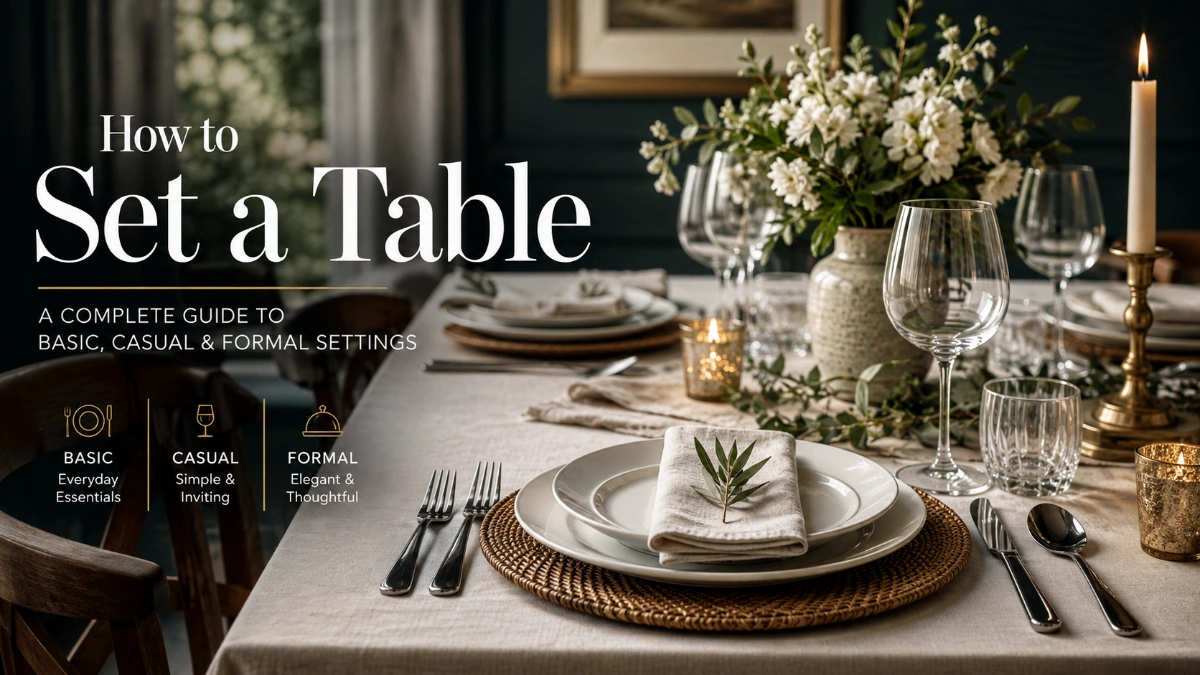
How to Set a Table: Quick Guide Knowing how to set a table becomes much easier when you remember a few basic placement rules: The basic setting is enough for most everyday meals. Casual settings add a few pieces for additional courses, while formal settings use more utensils, glassware, and sometimes a charger plate. What […]
How to Set a Table: Quick Guide
Knowing how to set a table becomes much easier when you remember a few basic placement rules:
- Dinner plate: Centre it in front of the diner.
- Napkin: Place it to the left of the fork or on the plate.
- Fork: Place it to the left of the plate.
- Knife: Place it to the right of the plate, with the blade facing inward.
- Spoon: Place it to the right of the knife.
- Water glass: Position it above the knife, slightly to the right.
- Wine glass: If used, place it to the right of the water glass.
- Additional utensils: Arrange them according to the order in which they will be used, working from the outside toward the plate.
The basic setting is enough for most everyday meals. Casual settings add a few pieces for additional courses, while formal settings use more utensils, glassware, and sometimes a charger plate.
What Goes Where on a Table?
| Table Item | Standard Placement |
| Dinner plate | Center of the place setting |
| Napkin | Left of the fork or on the plate/charger |
| Dinner fork | Left of the plate |
| Salad fork | To the left of the dinner fork when needed |
| Knife | Right of the plate, blade facing inward |
| Spoon | Right of the knife |
| Bread plate | Above the forks |
| Butter knife | On the bread plate, blade facing inward |
| Water glass | Above the dinner knife |
| Wine glass | To the right of the water glass |
| Dessert utensils | Above the plate in a formal setting or brought out with dessert in a casual setting |
| Charger | Under the first-course plate in a formal setting |
The exact arrangement can change depending on the meal and number of courses. The key is to set out only the pieces that diners will actually need.
The Basic Table Setting
A basic table setting is the best place to start because the same left-and-right arrangement forms the foundation of more elaborate settings.
For an everyday meal, you generally need a dinner plate, napkin, fork, knife, spoon, and glass.
How to Set a Basic Table
- Place the dinner plate in the center of the setting.
- Put the napkin to the left of the fork or fold it on top of the plate.
- Place the fork to the left of the plate, with the tines facing up.
- Place the knife to the right of the plate, with the blade facing toward the plate.
- Put the spoon to the right of the knife.
- Position the water glass above the knife, slightly to the right.
That’s a complete, functional table setting for a typical everyday meal. It keeps the items a diner needs within easy reach without unnecessarily crowding the place setting.
Basic Table Setting at a Glance
| Item | Where It Goes |
| Plate | Center |
| Napkin | Left of fork or on plate |
| Fork | Left of plate |
| Knife | Right of plate, blade inward |
| Spoon | Right of knife |
| Water glass | Above/right of knife |
The Casual Table Setting
A casual table setting works well for dinner parties, potlucks, holidays, and meals that include more than one course without requiring a fully formal arrangement.
The basic layout stays the same, but additional pieces are added when the meal calls for them.
How to Set a Casual Table
- Place the dinner plate in the center.
- Put the napkin to the left of the fork or on the plate.
- Place the dinner fork to the left of the plate.
- Add a salad fork farther to the left when a salad course is being served.
- Place a salad plate or bowl above the forks when appropriate.
- Put the bread plate above the forks, with a small butter knife resting on its edge and its blade facing inward.
- Keep the water glass above the knife.
- If wine is served, place the wine glass to the right of the water glass.
- Bring dessert utensils out with dessert if you prefer not to pre-set them.
The important principle is simple: only add utensils and dishes that correspond to the meal being served.
Casual Table Setting Example
For a meal with a main course, salad, bread, water, and wine, the arrangement can include:
Left of the plate:
Salad fork → Dinner fork
Right of the plate:
Dinner knife → Spoon
Above the plate area:
Bread plate
Above/right of the knife:
Water glass → Wine glass
This keeps the basic layout intact while adding only the pieces needed for the meal.
The Formal Table Setting
Formal table settings are designed for multi-course meals such as formal dinners, weddings, and other occasions where several courses may be served.
The most important rule is the outside-in principle: utensils are generally arranged according to the order in which they will be used. The utensil for the first course is placed farthest from the plate, while the utensil for a later course is positioned closer to the plate.
Forks generally go on the left, while knives and spoons go on the right. The oyster fork is the notable exception and is placed on the right with the spoons.
Formal Table-Setting Rules
For example, if a meal includes salad, fish, and a main course, the utensils can be arranged so that the diner uses them from the outside toward the plate:
Salad → Fish → Main course
This means the utensils for those courses are positioned in that same sequence from outside to inside.
Because formal meals can have different course orders, there is no single rigid arrangement that applies to every formal dinner.
Formal Table Setting Placement
| Item | Placement |
| Charger plate | Center, underneath the first-course plate |
| Napkin | To the left of the forks or centered on the charger |
| Salad, fish, and dinner forks | Left of the plate, arranged outside-in by course |
| Dinner and fish knives | Right of the plate, arranged outside-in by course |
| Spoon | Right of the knives |
| Oyster fork | Right side, next to the spoons |
| Dessert fork and spoon | Above the plate in a traditional formal arrangement |
| Water glass | Above the dinner knife |
| Wine glasses | To the right of the water glass |
| Place card | Above the plate or charger, if used |
What Is a Charger Plate?
A charger is a decorative base used underneath the first-course plate in a formal table setting. It is not normally used as the plate from which food is eaten.
A charger can help protect the table from heat and dishware marks while also providing a finished appearance.
The charger may be removed before the main course arrives or later with the empty dinner plate before dessert. The important point is that it should not remain on the table through dessert.
How to Set a Table for Dinner
If you’re setting a table for a normal dinner rather than a highly formal event, start with the basic arrangement and then add pieces according to the menu.
Follow These Steps
- Decide which courses you’re serving.
The menu determines which utensils and dishes are actually necessary. - Place the dinner plate in the center.
- Add the napkin.
Put it to the left of the fork or on the plate. - Arrange the forks on the left.
Add additional forks only when another course requires them. - Arrange the knife and spoon on the right.
Keep the knife blade facing toward the plate. - Add the bread plate if bread is being served.
- Position the water glass above the knife.
- Add wine glasses if wine is being served.
- Add dessert utensils if appropriate.
For a casual dinner, these can usually be brought out with dessert.
This approach prevents the table from becoming unnecessarily crowded while still giving every diner the utensils they need.
Basic vs. Casual vs. Formal: What Actually Changes?
Basic, casual, and formal settings are not completely different systems. They use the same core placement rules, with additional pieces added as the number of courses and level of formality increase.
| Setting Type | Typical Occasion | Items Beyond the Basics |
| Basic | Everyday meals | Plate, napkin, fork, knife, spoon, glass |
| Casual | Dinner parties, holidays, potlucks | Salad fork, bread plate, water and wine glass |
| Formal | Weddings, formal dinners, multi-course meals | Charger, multiple forks and knives, multiple glasses, place card, oyster fork if needed |
The easiest way to remember the difference
Basic: Set what you need for one straightforward meal.
Casual: Start with the basic setting and add pieces for additional courses.
Formal: Arrange multiple utensils and glasses according to the courses being served.
Where Should the Fork, Knife, and Spoon Go?
The easiest rule to remember is:
Forks go on the left. Knives and spoons go on the right.
The knife blade faces inward toward the plate.
When multiple utensils are needed, arrange them according to the order in which they will be used, generally working from the outside toward the plate.
The oyster fork is an exception to the usual fork-left rule and is placed on the right near the spoons.
Where Do the Glasses Go?
The water glass is positioned above the dinner knife.
When wine is served, the wine glass is placed to the right of the water glass. Additional wine glasses can be added when different wines are served during a multi-course meal.
The exact arrangement can vary with the number of glasses required, but keeping the water glass above the knife provides a useful starting point.
Where Does the Napkin Go?
There are two common options:
- Place the napkin to the left of the fork.
- Fold the napkin and place it on top of the plate or charger.
For an everyday or casual meal, either approach can work. A more styled or formal setting may use a folded napkin on the plate or charger.
Common Table-Setting Mistakes
A few mistakes can make an otherwise well-organized table look confusing. Most are easy to fix.
1. Facing the knife blade outward
The knife blade should face toward the plate rather than outward.
2. Adding utensils that won’t be used
Don’t put out a soup spoon if soup isn’t being served. The same principle applies to other specialized utensils.
3. Putting forks on the wrong side
The standard arrangement places forks on the left and knives and spoons on the right, with the oyster fork as the notable exception.
4. Forgetting the outside-in rule
For multiple courses, arrange utensils according to the order in which diners will use them.
5. Adding too many glasses
Only provide the glassware required for the meal. A crowded table can make an otherwise elegant setting difficult to use.
6. Treating a charger as a dinner plate
A charger is a decorative base rather than the plate used for eating.
7. Leaving the charger through dessert
The charger should be removed no later than the point when dessert is served.
8. Reversing the dessert utensils
In a traditional formal arrangement, the dessert spoon is positioned above the dessert fork, with their handles oriented in opposite directions.
Table-Setting Rules to Remember
If you don’t want to memorize an entire diagram, remember these core rules:
- Plate in the center.
- Forks on the left.
- Knives and spoons on the right.
- Knife blade faces the plate.
- Water glass goes above the knife.
- Wine glasses go to the right of the water glass.
- Use the outside-in rule for multiple courses.
- Set out only the utensils needed for the meal.
- A charger sits beneath the first-course plate in a formal setting.
- The oyster fork is the exception to the usual fork-left rule.
Once these rules become familiar, moving from a basic to a casual or formal setting becomes much easier.
FAQs
Both are acceptable placements. In a casual setting, the napkin can go to the left of the fork, while a more styled or formal setting may place a folded napkin on top of the plate or charger.
The oyster fork is the exception. It is placed on the right side of the setting near the spoons.
No. A charger is generally associated with more formal settings and is not necessary for a basic or casual table setting.
Start with the utensils needed for the meal you’re serving. If there are multiple courses, arrange the utensils according to their order of use, generally from the outside toward the plate.
The water glass sits above the dinner knife. Wine glasses are placed to its right when wine is being served.
The bread plate is positioned above the forks. A small butter knife can rest on the bread plate with its blade facing inward.
Either approach can work depending on the setting. In a casual meal, dessert utensils are commonly brought out with dessert. In a formal setting, they may be pre-set above the plate.
A charger can be removed just before the main course arrives or later with the empty dinner plate before dessert. It should not remain on the table through dessert.
An informal or casual setting uses a moderate number of utensils and dishes based on the meal being served. A formal setting is designed for multi-course meals and can include a charger, multiple utensils, multiple glasses, and a place card.
Yes. You do not need a specialized utensil for every possible course. Use the pieces you have and choose a practical arrangement based on the meal you’re serving.