



Farmers’ Almanack: Weather, Gardening, Moon Phases & Uses A farmers’ almanack is an annual guide built around the changing seasons. It brings together broad weather outlooks, garden-planning calendars, Moon and daylight information, practical household material, and traditional folklore. Farmer’s Almanack Start With the Right Resource A farmer’s almanack is useful for a seasonal perspective, but […]
Farmers’ Almanack: Weather, Gardening, Moon Phases & Uses
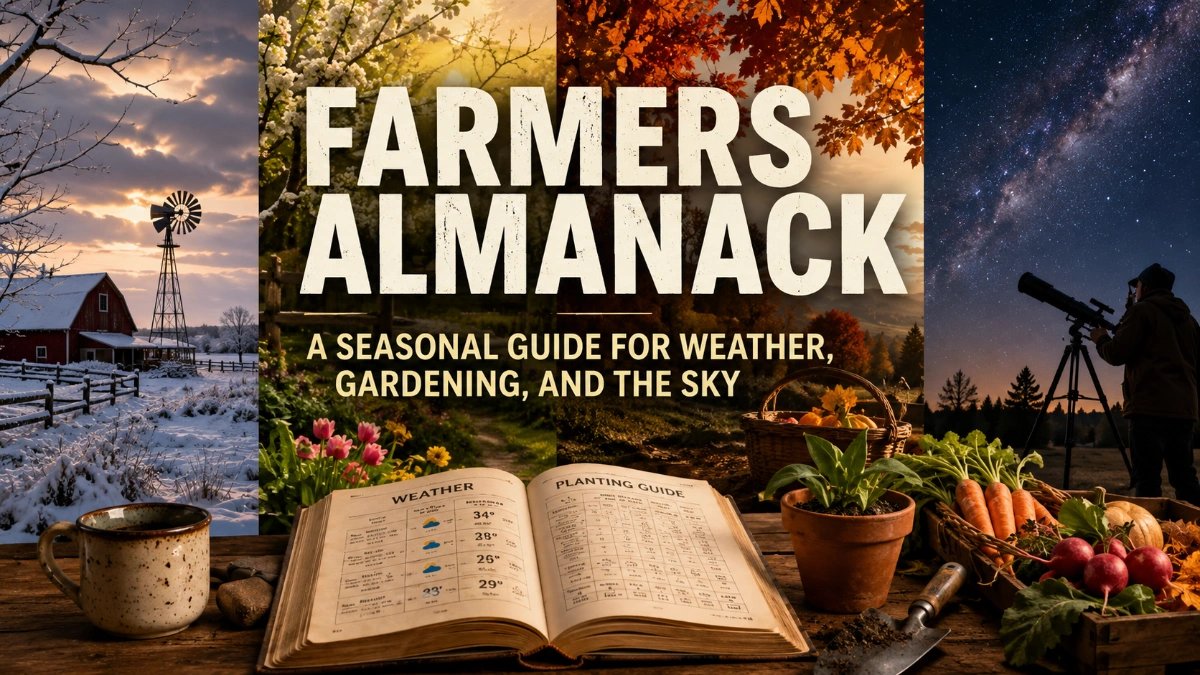
A farmers’ almanack is an annual guide built around the changing seasons. It brings together broad weather outlooks, garden-planning calendars, Moon and daylight information, practical household material, and traditional folklore. Farmer’s Almanack
- The phrase can mean the general type of publication, but it can also refer to either Farmers’ Almanac or The Old Farmer’s Almanack. They are separate titles, so identifying the exact publication is the first step before using a forecast, planting calendar, or Moon guide.
Start With the Right Resource
A farmer’s almanack is useful for a seasonal perspective, but it should not be asked to do the job of a live weather service. The value lies in helping readers organise a year of gardening, outdoor activity, skywatching, and seasonal routines.
It commonly contains:
- Broad long-range or seasonal weather outlooks
- Gardening calendars and suggested seasonal tasks
- Moon phases, full Moon dates, and daylight information
- Solstices, equinoxes, and other annual sky markers
- Household tips, recipes, folklore, and traditional observations
Farmers’ Almanack publishes weather forecasts, gardening resources, Moon dates, planning calendars, and “Best Days” tools. The Old Farmer’s Almanack also offers weather material, gardening information, Moon phases, sunrise and sunset times, tide charts, folklore, and related calendar features.
Tell the Two Almanacs Apart
The titles look similar, but they do not identify one shared publication. Use the label on the cover, page, or website rather than assuming that a result for “Farmers’ Almanack” comes from the source you had in mind.
| What to check | Why it helps |
| The full publication name | Farmers’ Almanack and The Old Farmer’s Almanack are different titles |
| The edition year | An annual calendar or printed forecast applies to a particular publication cycle |
| Your region or entered location | Weather, frost timing, and seasonal conditions vary by place |
| The feature you are viewing | A planting calendar, a Moon calendar, a daily planner, and a weather outlook answer different questions |
| Print versus online format | Online calendar tools may be updated, while print editions are fixed for their publication year |
This distinction matters most when a reader is comparing a forecast, a planting recommendation, or a calendar date.
Read Weather Information Correctly
Future-looking weather resources operate at different scales. Knowing their limits helps you choose the right one for the decision in front of you.
| Type of information | What it can help with | What it cannot reliably provide |
| Current local forecast | Near-term plans, travel, work, and outdoor activities | A full season’s weather |
| Seasonal outlook | General preparation for possible temperature or precipitation patterns | Conditions at one address on one date |
| Climate outlook | Broad probabilities for a month or season compared with typical conditions | Exact temperatures, rainfall totals, or individual storms |
| Official warning or alert | Immediate safety decisions during hazardous conditions | Seasonal planning |
Weather is what the atmosphere is doing in the short term: changes in temperature, pressure, moisture, wind, cloud cover, and storms. Because these conditions can change rapidly, a current local forecast is the appropriate source for decisions that depend on the next few hours or days.
Seasonal and climate outlooks answer broader questions. They indicate the likelihood of general conditions across a larger area and time period, rather than promising that a particular day will be wet, dry, hot, or stormy.
Good Uses for Almanack Outlooks
Use a farmers almanac as a planning prompt when you want to:
- Think generally about an upcoming season
- Review outdoor, household, or garden preparation
- Add context to a seasonal calendar
- Explore weather traditions and historical seasonal reading
- Compare broad seasonal themes with local observations
When Current Information Matters
Choose current local forecasts and official alerts for:
- Severe weather and emergency preparation
- Travel and outdoor event decisions
- Frost protection and heat safety
- Rain, wind, or storm-sensitive work
- Decisions involving people, animals, crops, or property
The practical rule is simple: an almanac can inform long-term seasonal thinking, while current local information should guide time-sensitive action.
Plan Gardens From the Ground Up
A gardening calendar can be helpful, but the garden itself should make the final decision. Planting dates are most useful when they reflect the crop, the site, and current conditions.
Use This Order for Planting Decisions
- Find the local frost window and the expected growing season for the crop.
- Select varieties that suit the season, space, and regional conditions.
- Check soil temperature, drainage, fertility, and moisture.
- Confirm that the planting area receives enough light and airflow.
- Review the current forecast for cold, heat, heavy rain, or strong wind.
- Use an almanac calendar as an optional timing tool.
This sequence keeps local horticultural factors ahead of a generalized calendar. If soil remains cold, a late frost is possible, or heavy rain is approaching, those conditions outweigh a suggested planting date.
Where Moon-Phase Planting Fits
Moon-phase planting is an old calendar practice included by some almanacks. Farmers’ Almanac describes gardening by the Moon as part of its long-running approach and publishes dates for different garden tasks based on lunar timing.
Readers may enjoy using lunar phases to organize planting, transplanting, pruning, or harvesting. But Moon-based timing should be treated as a tradition, not as a guarantee of better germination, stronger plants, or larger yields.
For day-to-day garden success, place more weight on frost risk, suitable crop selection, soil condition, sunlight, water, pests, diseases, and current weather.
Use the Moon Calendar for the Sky
Moon phases and seasonal sky dates are among the most reliable and useful almanack features because they follow predictable astronomical cycles. They give readers a simple way to notice the passage of time beyond a standard monthly calendar.
Practical Astronomy Uses
A Moon or sky calendar can help you:
- Plan casual full-Moon or crescent-Moon observation
- Track the lunar cycle from new Moon to full Moon
- Notice changing sunrise and sunset times
- Mark solstices and equinoxes
- Plan outdoor time around available daylight
A lunar calendar tells you when the Moon reaches a phase. It cannot tell you whether clouds, rain, haze, or local conditions will allow you to see it, so pair sky dates with a current local forecast.
Separate Science From Tradition

A farmers almanac can contain astronomy, weather information, gardening advice, and folklore on the same page. These subjects connect through seasonal life, but they do not carry the same kind of evidence or certainty.
Astronomy
Astronomy studies the Sun, Moon, planets, stars, and other objects or events beyond Earth’s atmosphere. Moon phases, solstices, and equinoxes are predictable calendar events.
Weather
Weather describes short-term atmospheric conditions in a particular place, including temperature, precipitation, wind, humidity, clouds, and storms.
Climate
Climate refers to weather patterns over long periods. A climate outlook describes the possibility of broader future conditions relative to typical patterns; it does not predict a particular storm or a day’s exact weather.
Folklore
Folklore includes traditional sayings, customs, and observations passed through communities and generations. It contributes to the character of an almanack, but it is not a replacement for current weather guidance, safety advice, or evidence-based horticultural practice.
Why Almanacs Endure
Annual almanacks developed as compact household references when people needed one source for calendars, seasonal timing, planting ideas, astronomical dates, practical advice, and entertaining reading. Their format still works because it connects these parts of the year in one place.
A farmer’s almanack is best read as a seasonal companion: use it to plan, learn, and enjoy traditional calendar knowledge. When the decision is immediate or safety-critical, turn instead to current local forecasts and official alerts.
Frequently Asked Questions
A farmer’s almanack is an annual seasonal reference that commonly includes weather outlooks, gardening calendars, Moon phases, astronomical dates, practical advice, and folklore.
No. They are distinct publications that cover similar subjects, including weather, gardening, Moon information, and calendars.
No. An almanac is better used for broad seasonal context. Use a current local forecast for near-term conditions and official alerts for hazardous weather.
A seasonal outlook describes possible broad patterns, such as a greater likelihood of warmer, cooler, wetter, or drier conditions over a longer period. It does not forecast the exact weather on a specific day.
First consider frost timing, crop suitability, soil, light, water, and current weather. Use a calendar as an additional planning layer rather than the sole basis for planting decisions.
Planting by the Moon is a traditional practice used by some gardeners. It should not be viewed as a guaranteed way to improve growth or harvest results.
Moon phases are predictable astronomical events that support calendar planning, seasonal awareness, and casual skywatching.
Weather is the short-term condition of the atmosphere. Climate is the long-term pattern of weather in a region.
No. Use current local forecasts and official warnings for severe weather, travel, outdoor work, and other decisions where safety is involved.